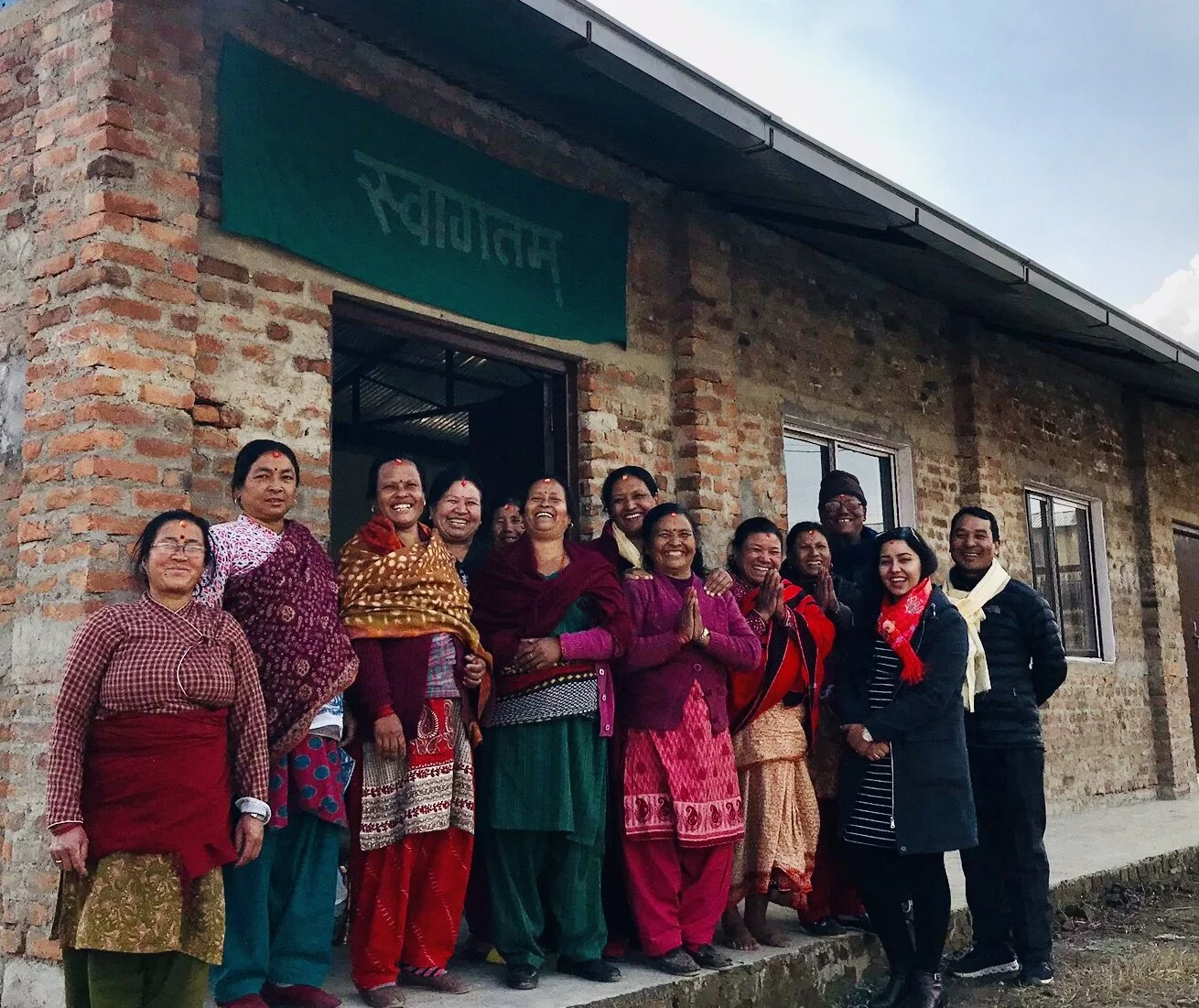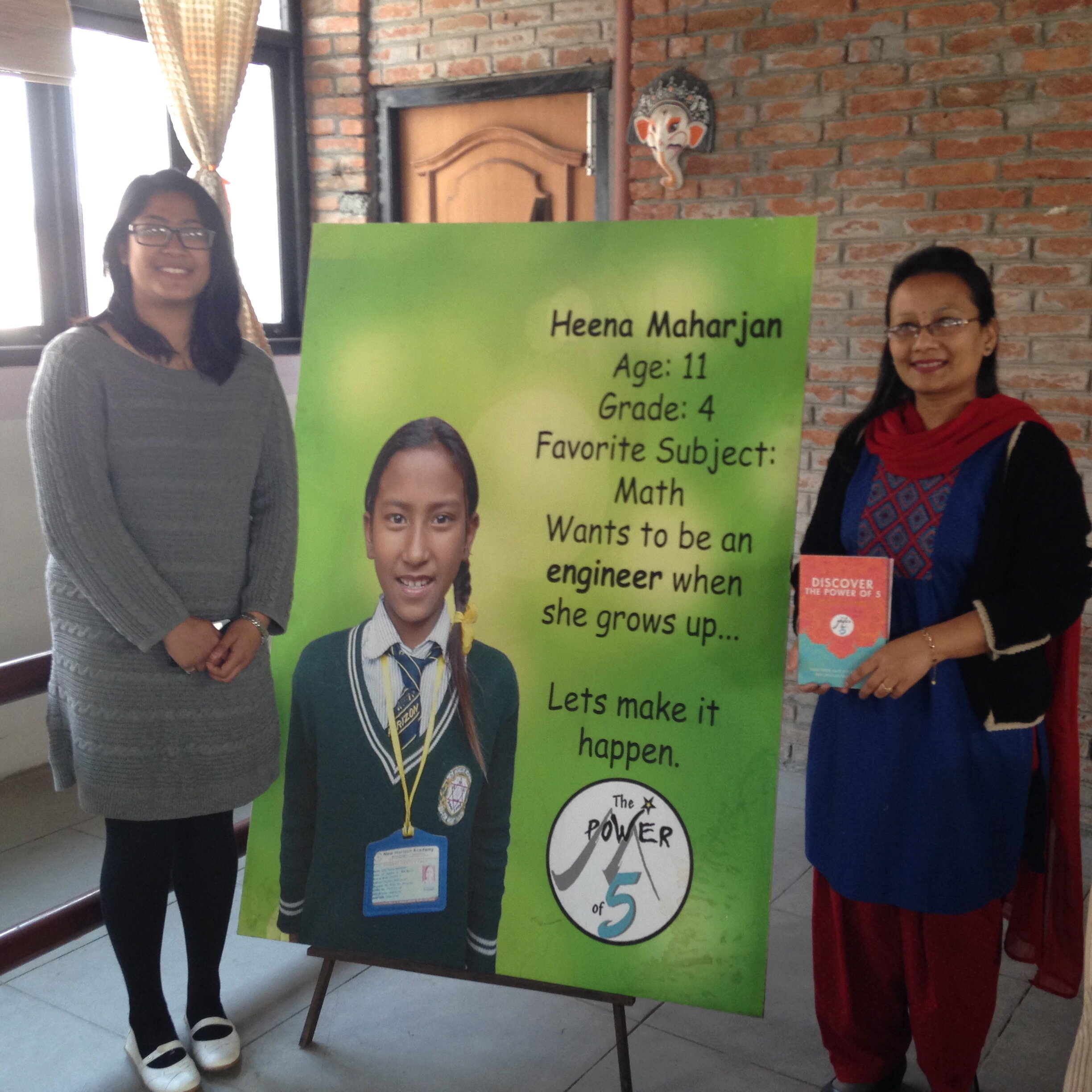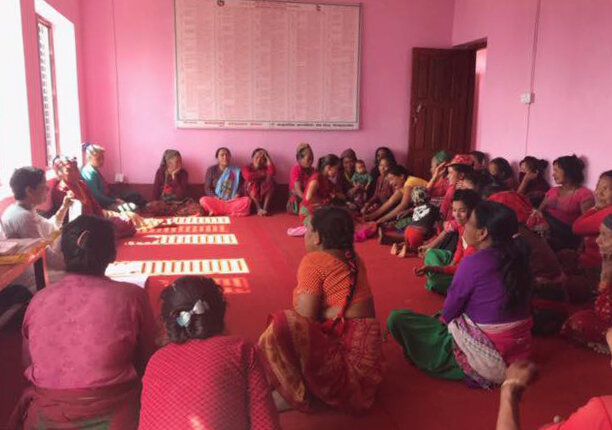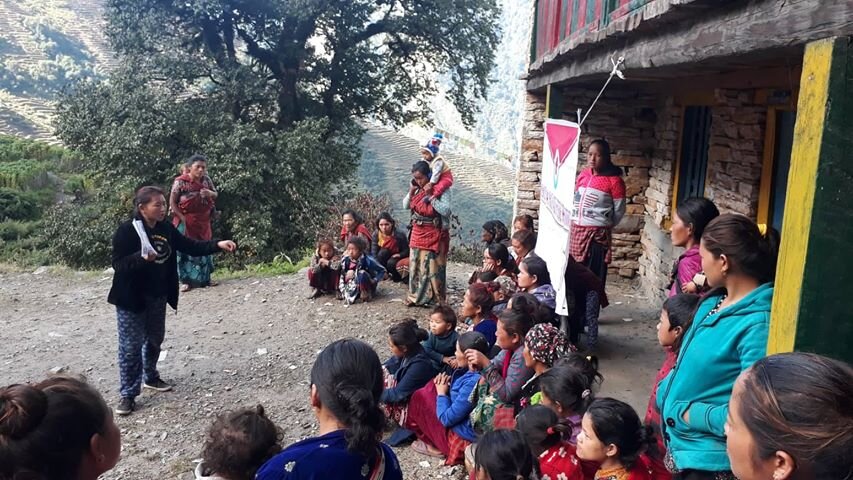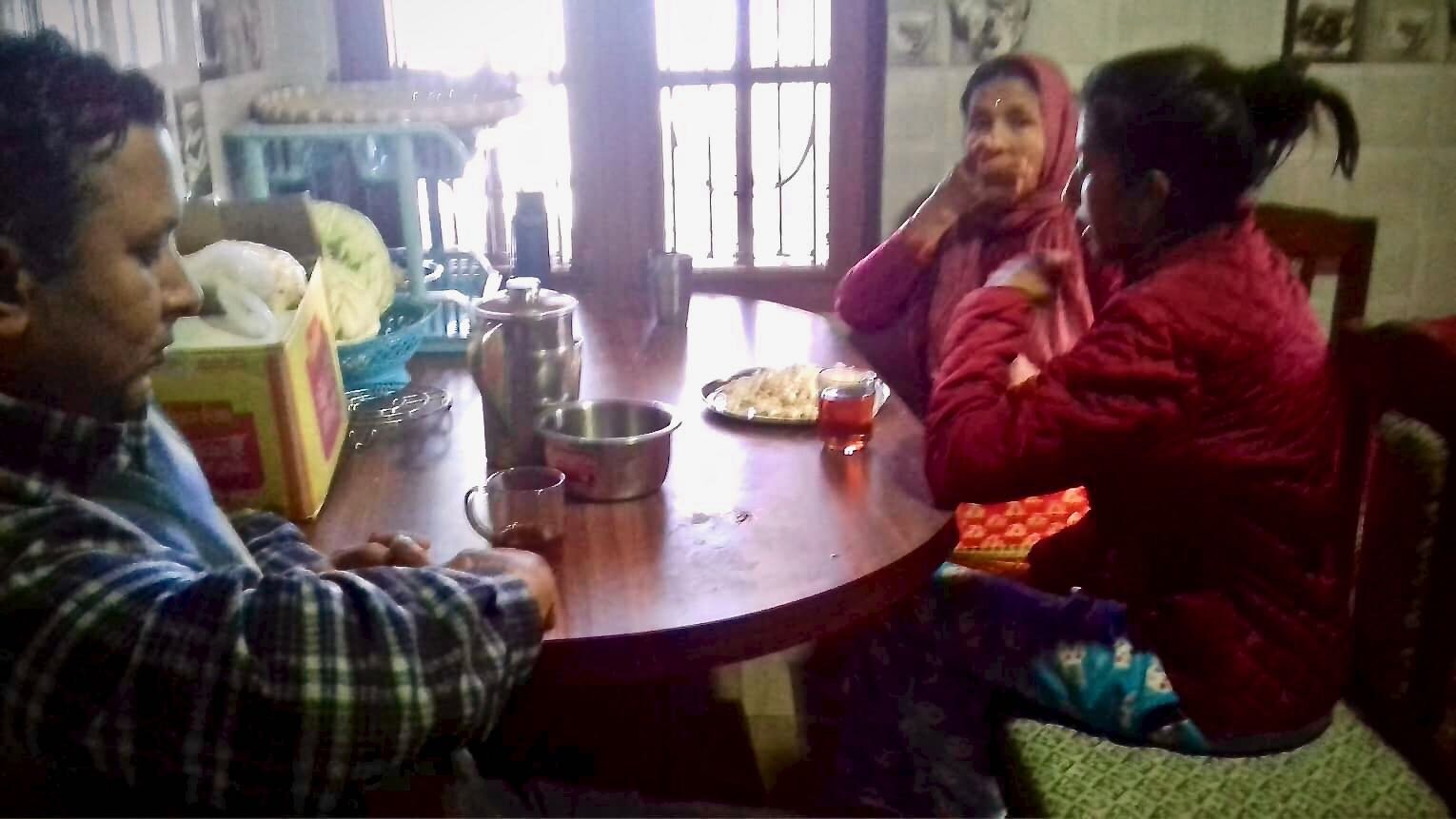
CCF Partners with Nilam Poudel to Create A Path Forward for Nepal's LGBTQIA Community.

The Story of Nilam

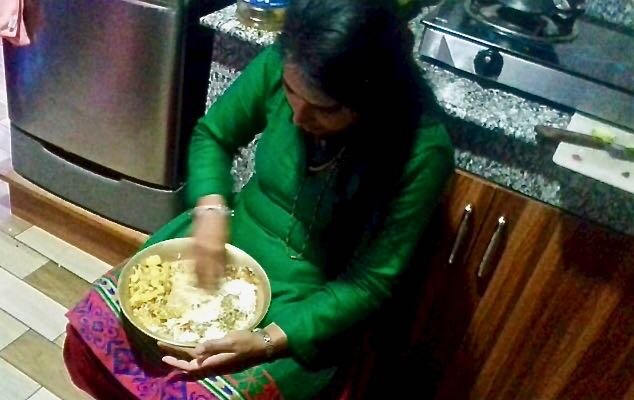
Nilam Poudel has organized for transgender rights for much of her life. From humble beginnings she has become a leading voice in the fight for trans rights across Nepal, especially when it comes to providing safe and sustainable employment for trans individuals. 

Her path to this role began in the early 2000s. While working as a child maid in Thailand to support her family of eight siblings in Nepal, Nilam took a chance: she enrolled in an extended makeup training course offered in Bangkok. Using the skills she developed, Nilam decided to start her own business—and with the income it provided her, she left her work to return to Nepal. As her business grew, she had the chance to work on several Hollywood movies (such as Black Narcissists to Our Girls) and fashion shows across the country. In her success, she recognized an opportunity for the hundreds of other trans men and women she knew in Kathmandu who were subject to the severe abuse and ostracization that she had grown up with. 

As in the United States, trans communities in Nepal are some of the most discriminated and marginalized groups. In 2007, Nepal’s Supreme Court made a groundbreaking decision on gender identity and sexual orientation that recognized equal rights for sexual minorities. The decision ordered the government to issue citizenship certificates and identity cards with a third gender option in the form of ‘other’. In 2015, Nepal joined a handful of countries around the world by adding protections for the LGBTQIA community in its constitution. 

Despite these progressive laws, however, discrimination and prejudice continued. Today, transgender individuals in Nepal continue to be excluded and rejected by their families, leaving them with few options to support themselves financially. Though sex work is illegal across Nepal, many trans women are forced to engage in it as the only means to provide for themselves.

Building Conscious Connections 
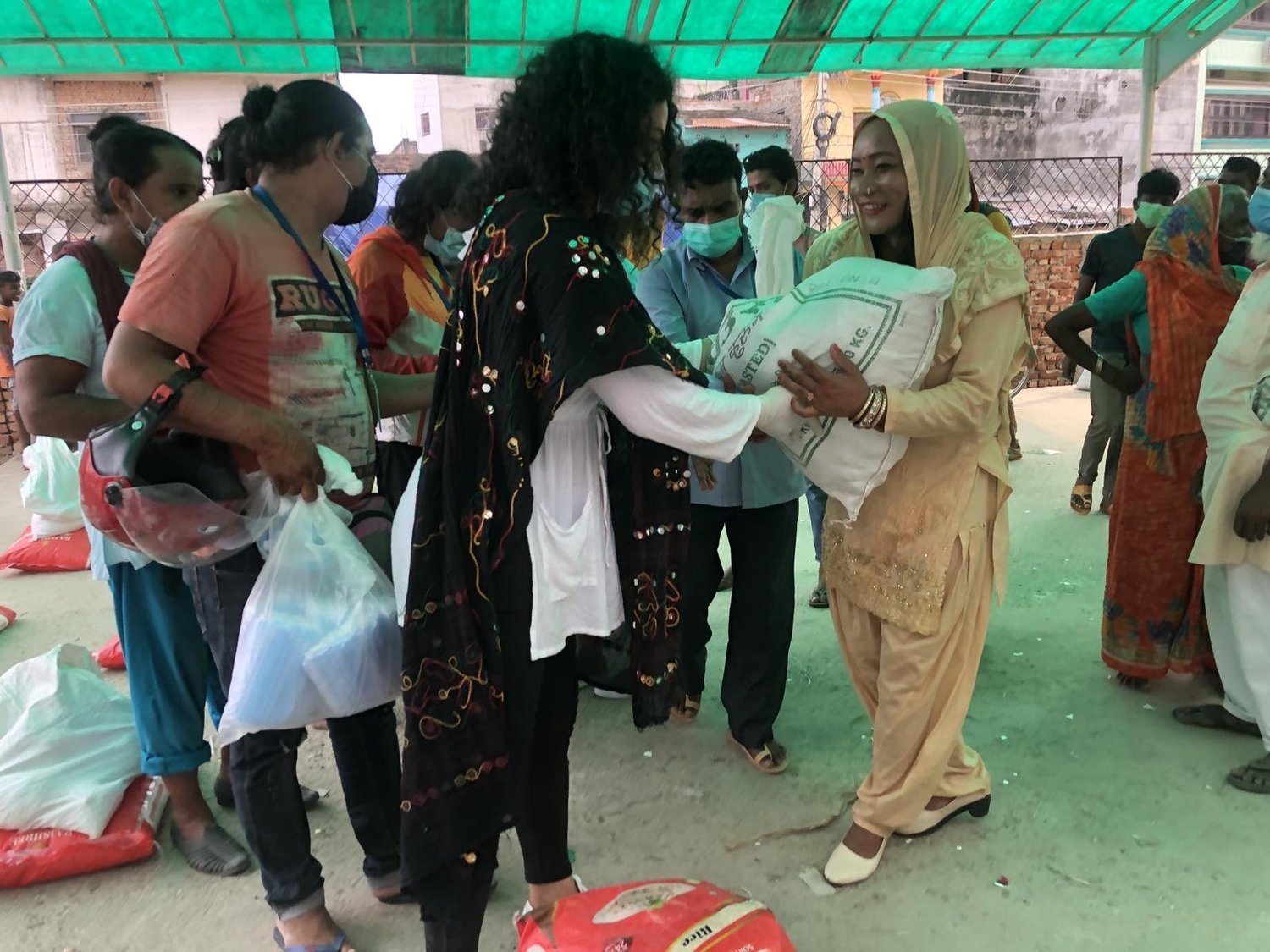
CCF first met Nilam during the initial stages of the COVID-19 pandemic in 2020 when she was trying to assist with many in the LGBTQIA community who had lost their jobs due to the lockdown. CCF Board member, Kesang Yudron, worked with Nilam to identify & distribute food rations to over 100 individuals throughout the Terai and Kathmandu. Because of the great work Nilam did in 2020, CCF worked with her again in 2021 when Covid hit Nepal the hardest. Distributing food, cooking gas and masks to another 95 individuals

As the pressures of the pandemic receded, Nilam and Kesang began examining more long term ways of addressing the adversity faced by the LGBTQIA community. Nilam had long dreamed of providing other trans women with skill training programs like the makeup training she had received so participants could have the opportunity to leave sex work. In June of 2022, CCF partnered with Nilam once again to make this dream a reality.  

“The First Trainings of their Kind” 

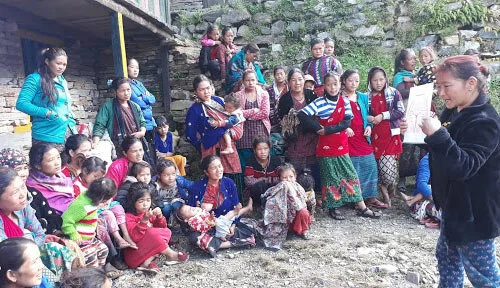
With funding by CCF and on the ground support through Kesang, Nilam worked to organize two, 11-day certification courses for participants to learn about makeup and beautician practice. The first trainings of their kind in Nepal, they brought together 62 LGBTQIA participants from Itahari, Dharan, Biratnagar, Rajbiraj and Damak. Many of transgender participants were HIV positive and came from a background of sex work while others, like Nilam, were long-time activists and organizers for Trans rights in Nepal. One such participant, Sunil, is a central point of contact for the LGBTQIA community on social media, helping people get access to medicine and psychological help. 

Not only did these trainings provide an opportunity to learn a new skill, but they allowed participants to build confidence and build new relationships within their LGBTQIA community. 
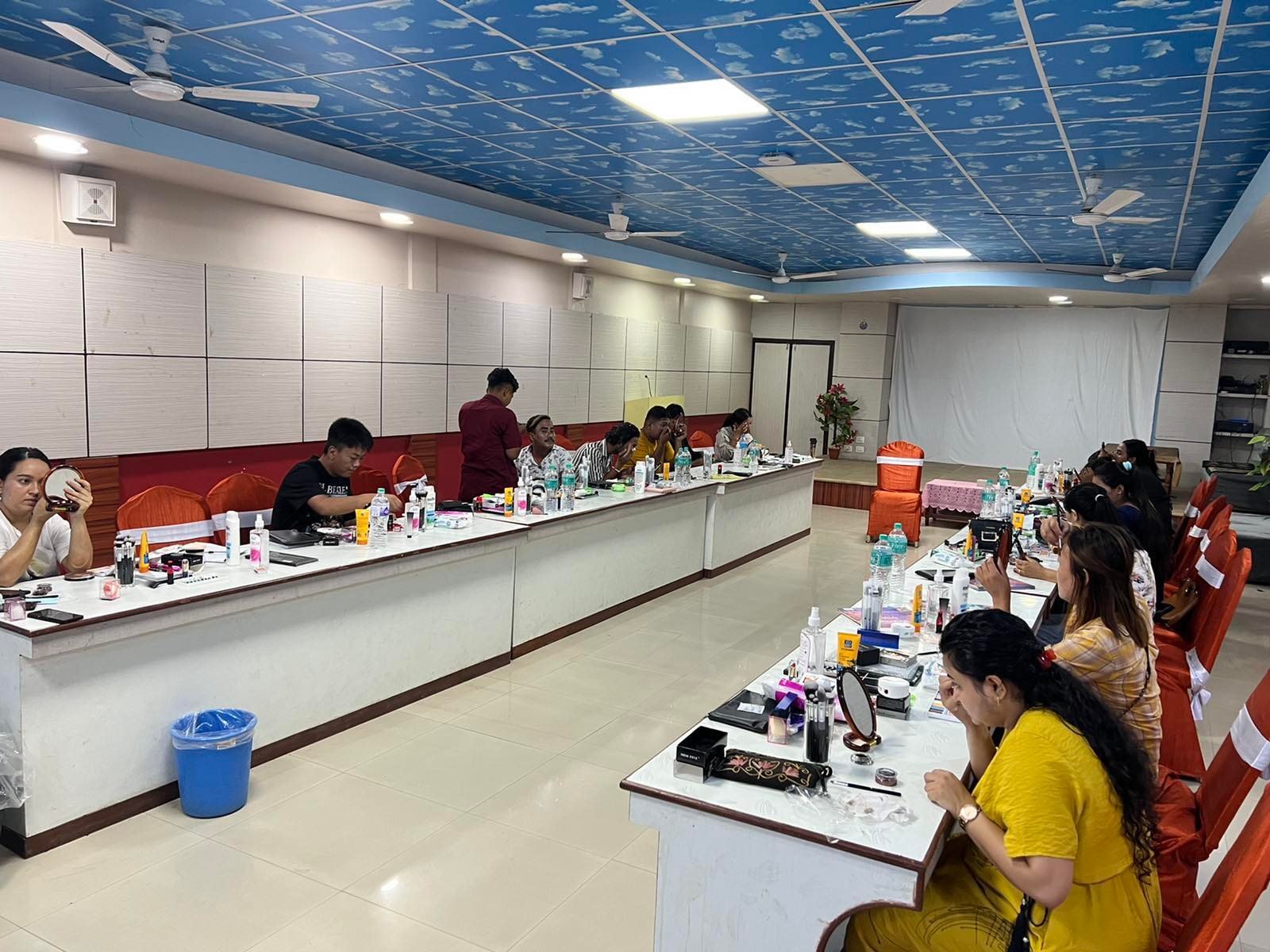
Included in these trainings was a day-long portion on how participants could start their own business and also a final certification of completion could be used to show to salons and potential clients. 

Three months later, Nilam’s hard work has paid off:

Three women are now in the process of opening their own beauty parlors in Southern Nepal. Nilam has been working with them to provide additional business support on how to open a beauty business. In a first for CCF, we have received several TikTok and Instagram photos with them showing their work in social media.

Others have found jobs in local salons or are doing freelance bridal makeup work. They are now making Rs. 10,000-12,000 per day—an amount equivalent to what it would take them a full month to make before. 
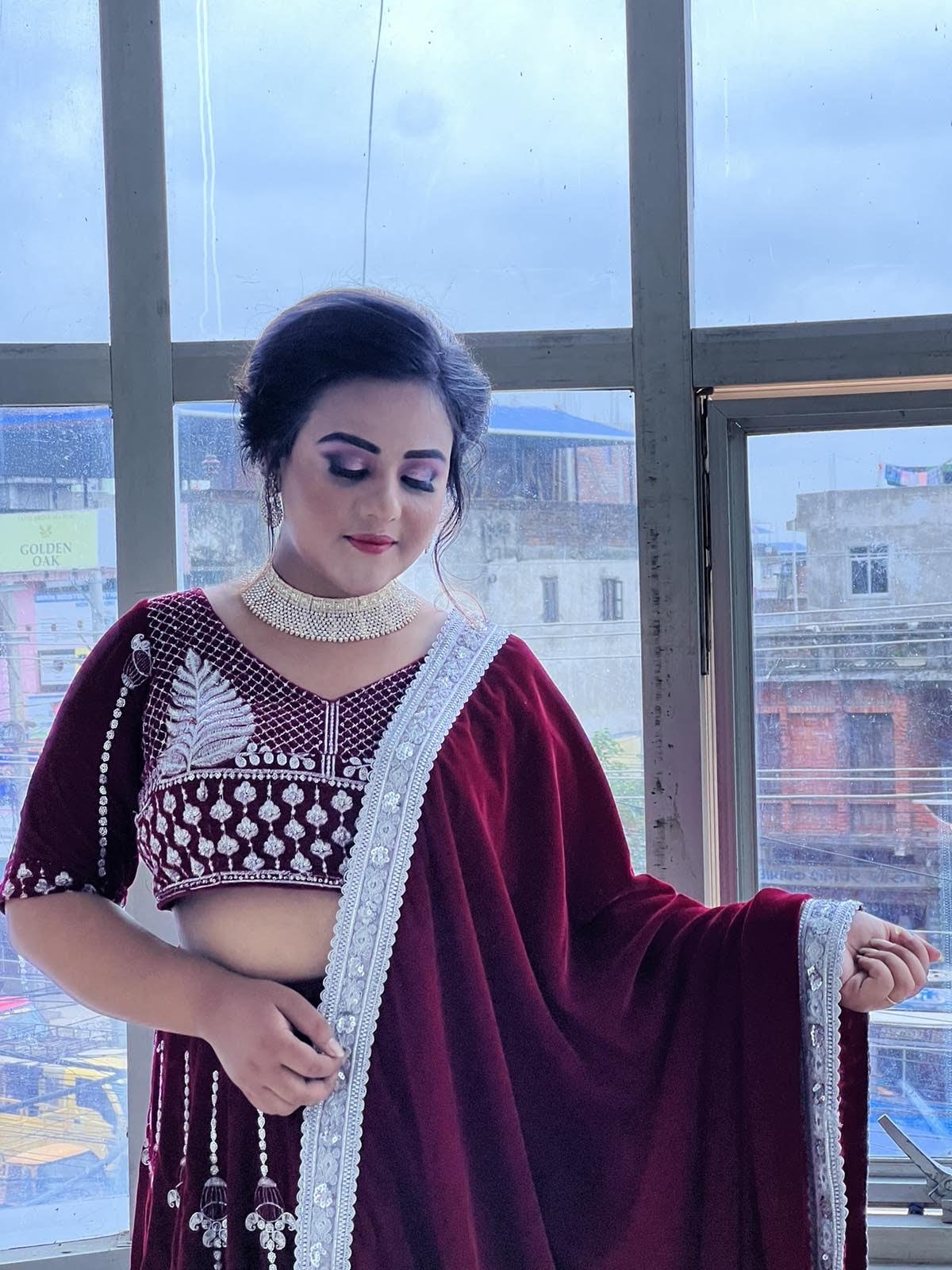
For Gita Katiwall, a 26 years old queer woman from the Terai, the makeup training meant giving her a confidence to walk outside with makeup which she had never done before. She is also currently applying for jobs at makeup studios. 

The Bigger Picture

The relationship between makeup and transgender individuals in Nepal is a complex one. For many trans women, makeup is the first step to embracing their own gender identity. In the Terai, Transgender people face a high rate of homicide and face a possibility of violence every day.  Many trans participants said that wearing makeup means not getting verbally and physically abused on the street. Being more accepted by society when they fit into the female form. For transgender men, make up was helpful in appearing in a more male form. 

CCF exists to invest in the power of women and girls to be key participants in their society. This cannot happen if we allow LGBTQIA communities to be ignored or left in the margins. Nilam’s work and that of the other 62 participants in these trainings will go on to have ripple effects far into the future. All of us look forward to being there to witness what that will look like. 

Double your CCF impact through Benevity’s Corporate Giving Program!

Does the company you work for participate in Benevity’s Spark Giving Program?

Thousands of companies do and Conscious Connections Foundation (CCF) is a non-profit registered in their network. That means you can give and get matching donations from your employer if you donate through them. Through the Benevity platform you can also create “giving opportunities” for CCF through their workplace giving program. You could potentially feature CCF’s work to your colleagues and even create peer matching opportunities.


Here’s a brief look at how Benevity works.
Benevity provides a donation platform that companies use to power their workplace giving and matching. Employees use their software to find their favorite charities—charities like CCF—and make donations and have their gifts matched by their employer. CCF receives the funds in a bundle monthly with no charges deducted.

If you know how to get onto your company’s Benevity site, search for Conscious Connections Foundation or enter our registered charity number 471602190 in the search bar of your workplace giving program portal (Spark).

If you are an existing donor who gives regularly to CCF outside of the Benevity platform please check to see if your employer has a workplace matching program that will maximize your gifts. Your donation of $25 could easily become $50 and that would keep a girl in school for 5 months or help us fund a part of a Menstrual hygiene training. The doubling helps us double our impact.

If your company has a Benevity Corporate Giving Program and you need help figuring out how to donate here are the instructions:

CCF is all volunteer run and the less time we spend searching for ways to fund our amazing and impactful projects the more time we have to do the actual work in Nepal.

Please contact your company’s internal giving program administrator for questions about this way of giving. Thanks and onward into helping CCF invest in the power of women and girls to be key participants in their society!

The Unseen Impacts of Covid & CCF’s Response—a Reflection

by Kesang Yudron & Denise Attwood

Covid-19 pushed the world into unprecedented times of uncertainty, disruption and chaos. As often is the case, people living in poverty and hunger suffered the most. With each wave of Covid-19, from early 2020 onward, cases skyrocketed in Nepal and strict lockdowns were enforced. Now in April of 2022 Covid has slowed for the moment and CCF wants to pause and reflect.

When Conscious Connections Foundation (CCF) initially set out to provide relief for communities that were hit hard by Covid, we knew there was a need for more vaccines, hospital facilities, better testing and quarantine facilities for migrant workers but we questioned our effectiveness in providing this type of relief. We connected with our Nepali partner organizations and community leaders to understand what needs they were seeing and they reported that the greatest need was hunger relief. 

With month-long lockdowns, daily wage workers lost their main source of income and families quickly ran out of money to buy food. People, without their daily wage, were starving. The Nepali government has no social protection plans to safeguard livelihoods and with lockdowns being extended for months on end, hunger was an immediate and immense issue. On the advice of our local partner organizations this is where we focused most of CCF’s 2020 & 2021  Covid relief efforts.

CCF made it our goal to work with local grassroots organizations focused on marginalized communities and vulnerable groups, including single mothers and children, daily wage workers, disabled and vulnerable individuals, people experiencing homelessness, victims of gender-based violence and communities marginalized by systemic societal oppression. 

Ayushma Rana—who lost her husband to the second Covid wave—ran an organization we were referred to. She had been providing food and medicine to single mothers, children and people living in slums. Once we got CCF funds in Nepal, through Ayushma, 65 families and 18 new mothers were supported with food parcels containing 10 kg of rice, 5 kg of lentils, 3 packets of salt, 1 kg of sugar, 24 small packets of biscuits, and 2 packets of mixed beans. This food ration would be sufficient for 1 month but we took solace in knowing that no one had to sleep on an empty stomach for some time. 

The Hiteri Foundation, was a group CCF supported from the early stages of Covid. Led by a passionate husband-and-wife duo, they worked relentlessly to organize and feed homeless and day laborer families during each lockdown. Every day Kusum and her husband cooked & packed free meals for 100-150 people in Lalitpur, Nepal where many day wage earners live. Most daily wage workers live in these central areas of Kathmandu because this is where they usually gather to find work for the day. They work in construction, plumbing, households as maids, as porters, and as roadside vendors. The majority of them come from villages in search of a better life for themselves and their  families. These workers have families that are dependent on their income and their source of income was gone due to the lockdowns. Kusum commented that construction laborers came saying that, despite lockdown rules getting relaxed, there was no work for them as tourism and construction had declined dramatically due to the virus. Tourism, alone, is one of the largest income earners in Nepal and provides direct and indirect jobs to over 4 million people.  

You can watch Kusum speak directly of their foundation’s work in this video here.


Menz Foundation is another grassroots organization CCF partnered with. Run by Menaz Khan who has a working station in Thamel, the central hub of tourism in Kathmandu, he worked with 5-6 volunteers each day, cooking, packing and managing the people who came for free meals. A month before the Covid pandemic started, Menaz Khan lost his father. His goal was to feed people as a way to remember and celebrate his father’s life. As he worked to feed people, he came to know individuals who were drinking only water and sugar to survive.  When the food distribution started each day, the volunteers called out the names of recipients to come and collect their food. The volunteers said, “The people are not afraid of Covid, they are afraid of being hungry”. If people have enough food, then they can stay home and be safe, rather than in crowds seeking food.


Nilam Poudel is another grassroots organizer that CCF worked with during Covid. Nilam is a trans woman who works for the LGBTQ+ community in Nepal. She is a model and has a successful business doing make up art and fashion designing. When Covid hit she wanted to volunteer to help the truly marginalized LGBTQ, and especially trans community, in Nepal and came to Kesang to seek assistance from CCF.

Through Nilam’s volunteer leadership, CCF was able to distribute food rations to LGBTQ/trans communities in rural parts of Nepal that had been hit hard by Covid. Because of prejudice and stigma, and estranged from their families, many trans people were without food and shelter, and this intensified as the pandemic continued over the years. Through the help of CCF, Nilam took overnight trips to Saptari, Ithari, Jhapa, Birgunj to distribute relief to these individuals. She talks about her work with the trans community and CCF in the interview here.

These are but a few of the groups CCF was able to help fund over the past few years of the Covid pandemic. In reflection the counsel of our Nepali partners to fund hunger relief proved to be a wise one. Many benefitted and made it through the pandemic through the basic provision of food and kindness. We could not have done any of this without your generous donations. 

As we look back, we are humbled by the bravery, sacrifice and extreme kindness of our Nepali partners as they volunteered countless hours, risked their own health, and created friendships with those who were in dire need of the basics of life; healthy food and compassion. Thousands were helped through this catastrophe by these amazing individuals. We could not have found better partners and want to extend our sincerest gratitude to all of them for the work that they have done and the lives they have helped save.

It is hard to find words to truly express how grateful CCF and our Nepali partners are for your support and generosity. Throughout the pandemic, communities of people from around the world came together to help each other in times of great need. That is truly the beauty of our human spirit.

Please check our Facebook and website for updates as we hopefully wind down our Covid Relief work and amp up our educational work in Nepal. 

Through Nepali-North American partnership, CCF invests in the power of women and girls to be key participants in their society.

Distributing Reusable Menstrual Pad Kits to Nepal’s Remote Regions

by Kesang Yudron

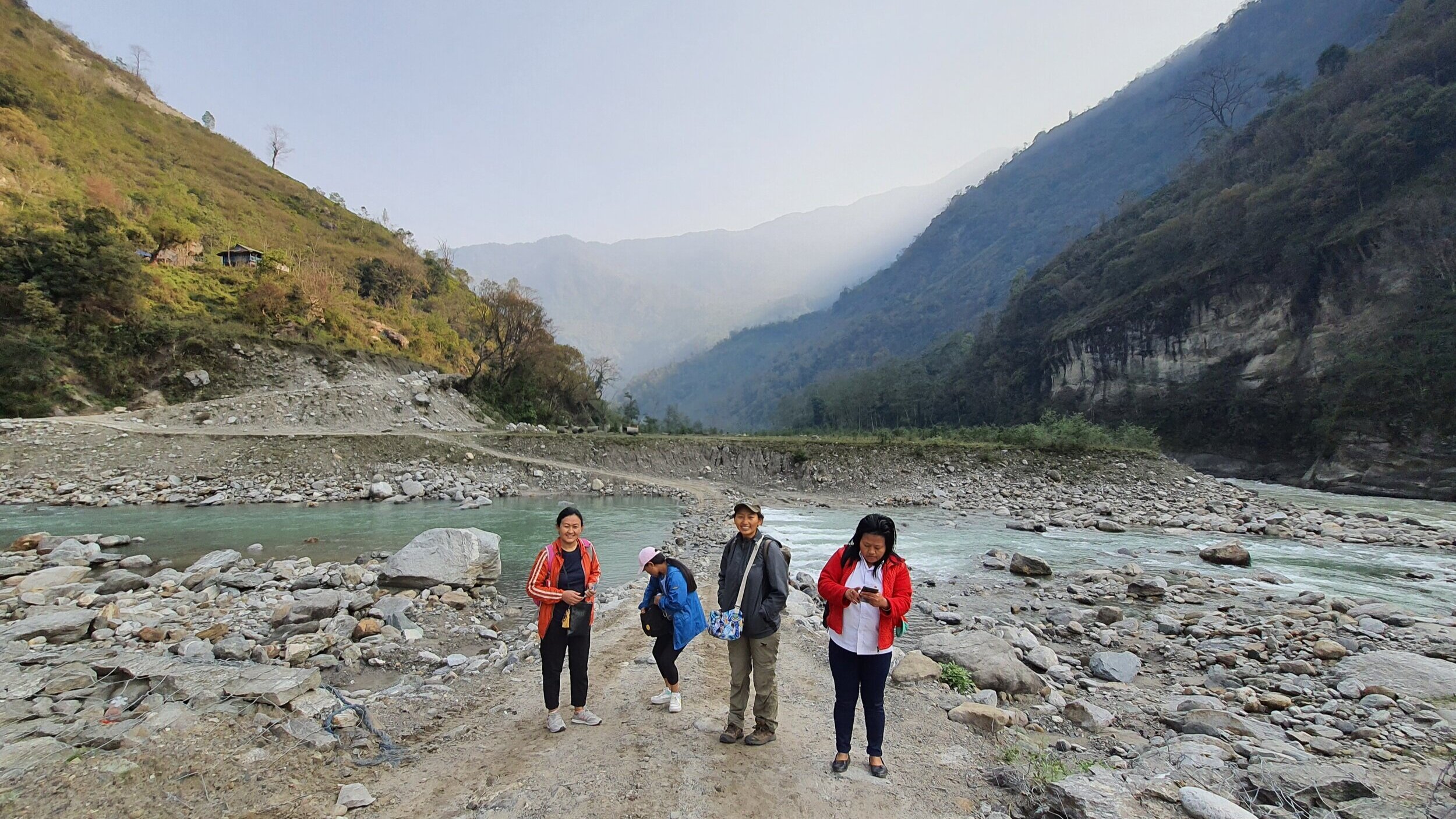
From left to right: Samjhana Lhomi, Somi Lhomi, Kesang Yudren and Chandrakala Rai

From left to right: Samjhana Lhomi, Somi Lhomi, Kesang Yudren and Chandrakala Rai

Surrounding us there is beauty and there is fear. The majesty of the mountains above us and the valleys below inspire awe in the natural world. The simplicity and lack of modernity in these isolated valleys of Sankhuwasabha, Nepal, equally inspire wonderment at human survival and endurance. Tucked snugly on the northeastern edge of Nepal, Barun Valley National Park is home to towering snow capped mountain peaks, high waterfalls and lush green forests that offer a remote wilderness experience that has been relatively untouched by humans. 

The inhabitants of this valley are Lhomi people, an indigenous community that have lived and subsisted on farming barley, potatoes and millet and traded wild herbs and plants for medicine for centuries. Living in difficult terrain with limited resources has meant many Lhomi women endure additional issues during menstruation. Historically, the women have been known to “free bleed” and/or use scraps of cloth which are hard to come by. In more recent years, the younger women have taken to using disposable sanitary pads but these are expensive to procure and their disposal leads to environmental challenges. 

Chhing Lhomi – Vice Chairperson of National Indigenous Federation (NWIF)

Chhing Lhomi – Vice Chairperson of National Indigenous Federation (NWIF)

Given these circumstances, the people from and around the region have struggled to connect with organizations or networks for support and resources. This need was highlighted by Chhing Lhomi, vice chairperson of National Indigenous Federation (NWIF), the chairperson of Lhomi Women Welfare Forum (LWWF), and the Himalayan Indigenous Society Nepal (HIS-Nepal). These organizations strive to work on behalf of indigenous women through social justice and women empowerment programs. Through my conversations with her, she was able to express the value and need for education on menstrual health and hygiene for the Lhomi women. That is how we set our plan to go to Sankhuwasabha. 

As CCF's Menstrual Hygiene program manager, I approached the CCF Board to see if they would be willing to work on this project. Since this program fell directly within CCF’s mission, board members talked with Chhing Lhomi and myself and agreed to fund the trainings, kits, and distribution of the CCF funded & newly completed Menstrual Hygiene manual.

With 2200 pounds of goods consisting of 3000 Menstrual Cloth Kits (2-day pads, 1 night pad, 5 liners, 1 soap, 2 underwear, 1 bag), fabrics, menstrual hygiene manuals and stationery supplies, we set out for Khat Bari, a region in Arun Valley. Preparation for this undertaking was challenging and was years in the making. To prepare we: 

Preparing kits for the Arun Valley

Preparing kits for the Arun Valley

  • Procured the PUL (water proof) fabric that prevents the pads from leaking from China,

  • Bought all the materials for the kits, refining the pattern every time we got feedback,

  • Trained four women for two years in how to sew menstrual kits (giving them sustainable income that uplifts them from poverty)

  • Created and published a Nepal centric Menstrual Health and Hygiene training manual in both Nepali and English for participants and communities to have as a resource and,

  • Figured out the logistics for transporting everything into a remote area with no telecommunication or roads during the Covid-19 pandemic. 

Each step of the way was carefully executed. With support and funding from Conscious Connections Foundation, a four-woman team of leaders, and the support of the local Lhomi village women, we were extremely well prepared to make this expedition happen. Together, our goal was to raise awareness on Menstrual Health and Hygiene and introduce rural girls/women to reusable, environmentally sustainable products while at the same time teaching them how to make their own cloth pads, helping their communities become more self-reliant. With that mission in mind, our group of four women, two locals, Somi & Samjhana and Jenny Shakya and myself took a 12 day trip into the Arun Valley. 

IMG_4602.jpg
IMG_4866.jpg
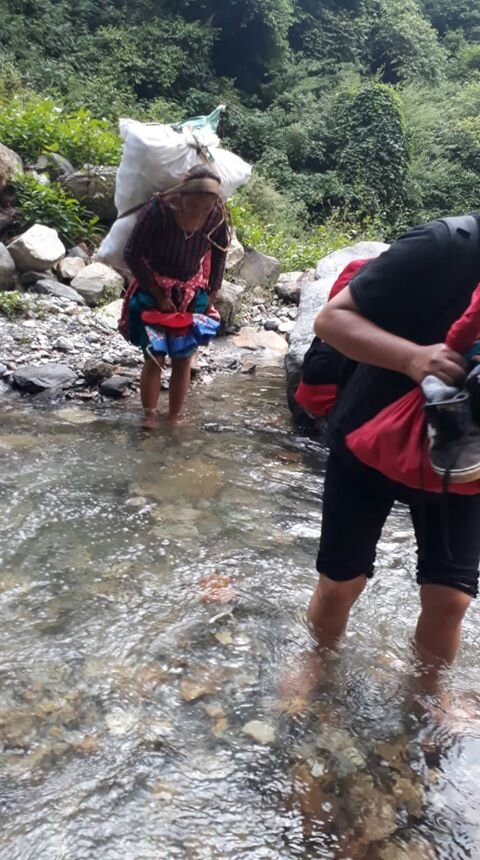
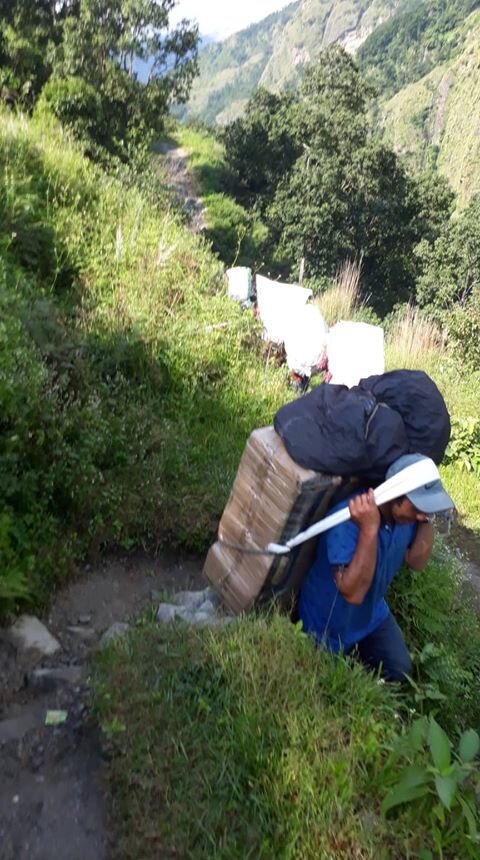
The Nepali version of Planes, Trains, and Automobiles – We transported over 3000 Menstrual Kits almost 100 miles.

The Nepali version of Planes, Trains, and Automobiles – We transported over 3000 Menstrual Kits almost 100 miles.

Together, we covered 80-90 miles hiking through deep gorges and waterfalls along Arun River. The Arun river enters from Tibet at an elevation of about 3500 meters (11,500 feet) and flows south across the district, forming one of the world’s deepest valleys relative to Makalu mountain at 8481 meters (27,825 feet) to the west and Kanchenjunga mountain at 8586 meters (21,869 feet) to the east. As we hiked up and down the evergreen trails, we were greeted by ‘Tashi Delek’ a Tibetan phrase which means, “May you be happy in the here and now” by friendly locals who asked us where we were headed as they sped past us on their daily walks. 

The locals we interacted with were friendly and had a matter of fact way of looking at life. Despite heavy rains and frequent landslides that blocked roads and made life precarious, they seem to be more joyful and accepting of the vicissitudes of life.  

In rural societies with limited access to technology and modernity, people seem to come together to help each other thrive and survive. As we moved from village to village, the locals helped us find a caravan of mules – the primary means of bringing the much needed menstrual supplies into the hinterlands of Sankhuwasabha. We started our first of three training sessions in Hattiya village followed by a similar training in Lingum village. We were welcomed by the Bhot Khola District Department of Education. Women pre-organized by Chhing Lhomi and myself came from eighteen neighboring villages to the trainings. We were interested in knowing their views, beliefs about menstruation and teaching them what we knew in the process. The participants were from all ages from 14 year old girls to 60-70 year old grandmothers. Lhomi women have less social and religious restrictions compared to Hindu women in Nepal, but still have limited access to menstrual products which makes them vulnerable to menstrual related illnesses. 

Menstruation is considered a natural process within the realms of Buddhism and some Lhomi women see menstrual blood as a powerful tool during Buddhist tantric rituals. Several female Tibetan deities, Dhakinis, are associated with menstruation but this portrayal is not widely acknowledged in Tibetan culture. Palden Lhamo is an icon in Tibetan Buddhism and represents the protector goddess whose wisdom and compassion overcome every obstacle. She is depicted riding a mule across a sea of menstrual blood serving as a metaphor for fertility. 

Despite the strong female Dhakinis in Buddhist tradition, the Lhomi women talked about how gendered roles still suppress women in Lhomi culture. Giving space during these trainings to the voices of the indigenous Lhomi women was a vital part of the learning process. Room was given for them to talk about their personal health issues without feeling embarrassed or ashamed.  Samjhana Lhomi, our trainer from Bhot Khola helped translate some of the topics into Lhomi and made the topic of menstruation lively with shared laughs and personal menstruation stories. Sonam, a Lhomi woman, said how her husband loves it when she has her periods and the room burst into laughter. 

Many women also claimed to ignore heavy menstrual bleeding and pain they feel during periods because they think it’s a normal part of menstruating. Many claimed that their husbands did not know anything about menstruation and they were too shy to share any information about their bodies. One of the moments that stuck with me was how many women said they used dry leaves & rags and ended up with bacterial or viral infections which got worse because there were no hospitals or clinics in their village.

IMG_4681.jpg

We worked on the basics of how menstruation happens, talked about the difference between gender and sex, female and male anatomy, the reproductive cycle, menstrual hygiene and about the pros and cons of different contraceptives in Nepal. The basics were a good introduction to the Lhomi women, as most had never had any kind of formal education and this was the first of its kind in Bhot Khola, Sankhuwasabha. Many expressed that it was the first time they heard about eggs in their bodies and were fascinated by the journey of an egg in the ovaries to the uterus. Most heard the word, ‘hormones' for the first time and nurse Samjhana Lhomi did an excellent job explaining the complex relationship between hormones and menstruation.

IMG-6916.jpeg

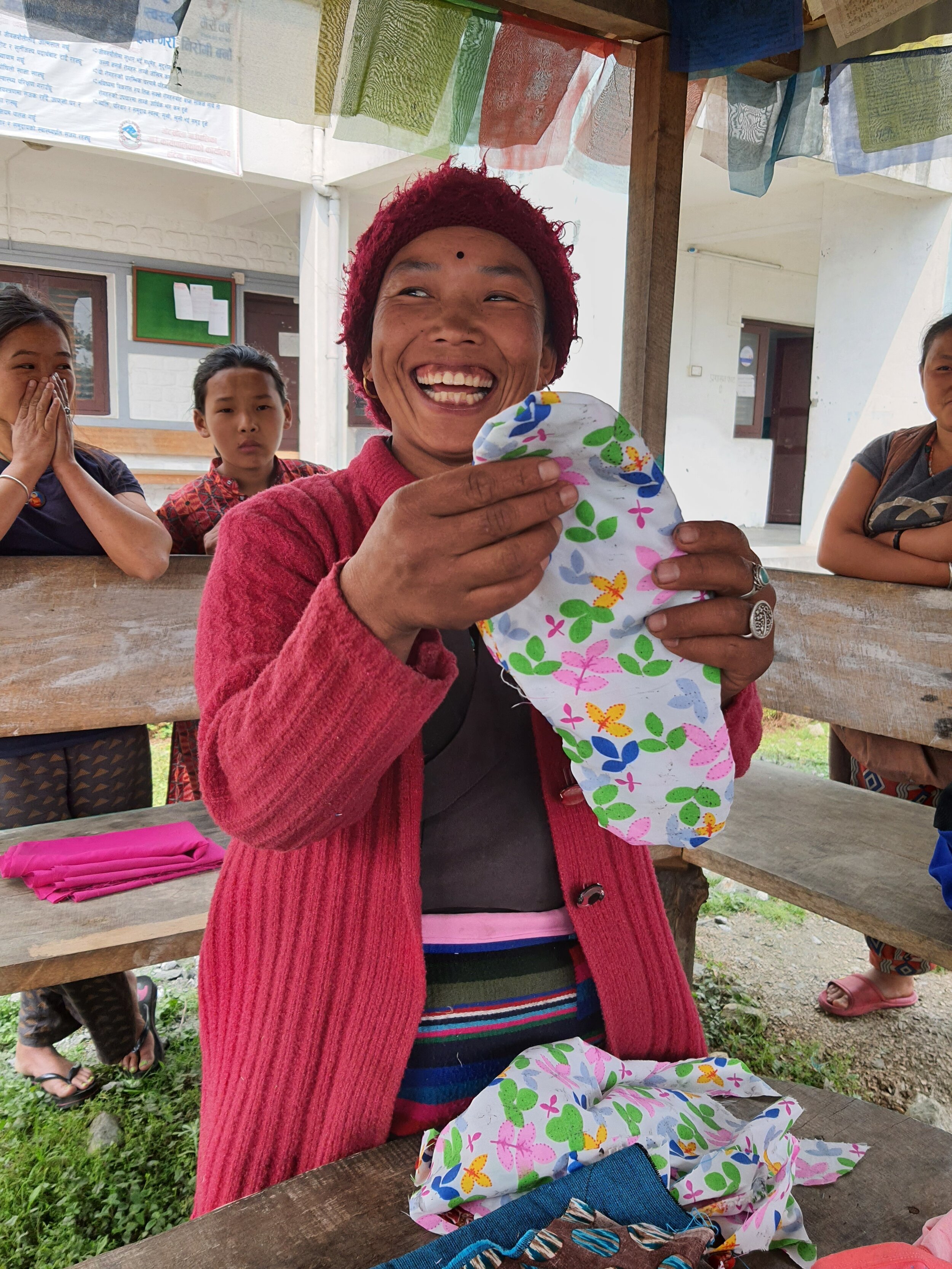
 As the saying goes, ‘Teach a woman to fish and you feed her for a lifetime’. We spent the second day of the training teaching each participant to make their own cloth pads. This training was a huge success overall because many learned how to cut, hand stitch and make their own cloth pads. Sanitary pads are very expensive in this region because they come all the way from India and cost Rs. 150 ($1.25), an expense most families find hard to bear. We also distributed PUL Waterproof cloth pad kits which consisted of 2 day pads, 1 night pad, 5 inner liners, 1 soap, 2 underwear, and 1 carrying bag to each participant and had them take more kits to distribute when they returned to their villages. Then each participant who came to the training, in turn, pledged to teach women and girls in their village community, thus widening the impact of the training and encouraging each participant to become a village leader. As I’m writing this blog post, we’ve had 7 villages send us photos of them teaching their community on how to make these cloth pads. 

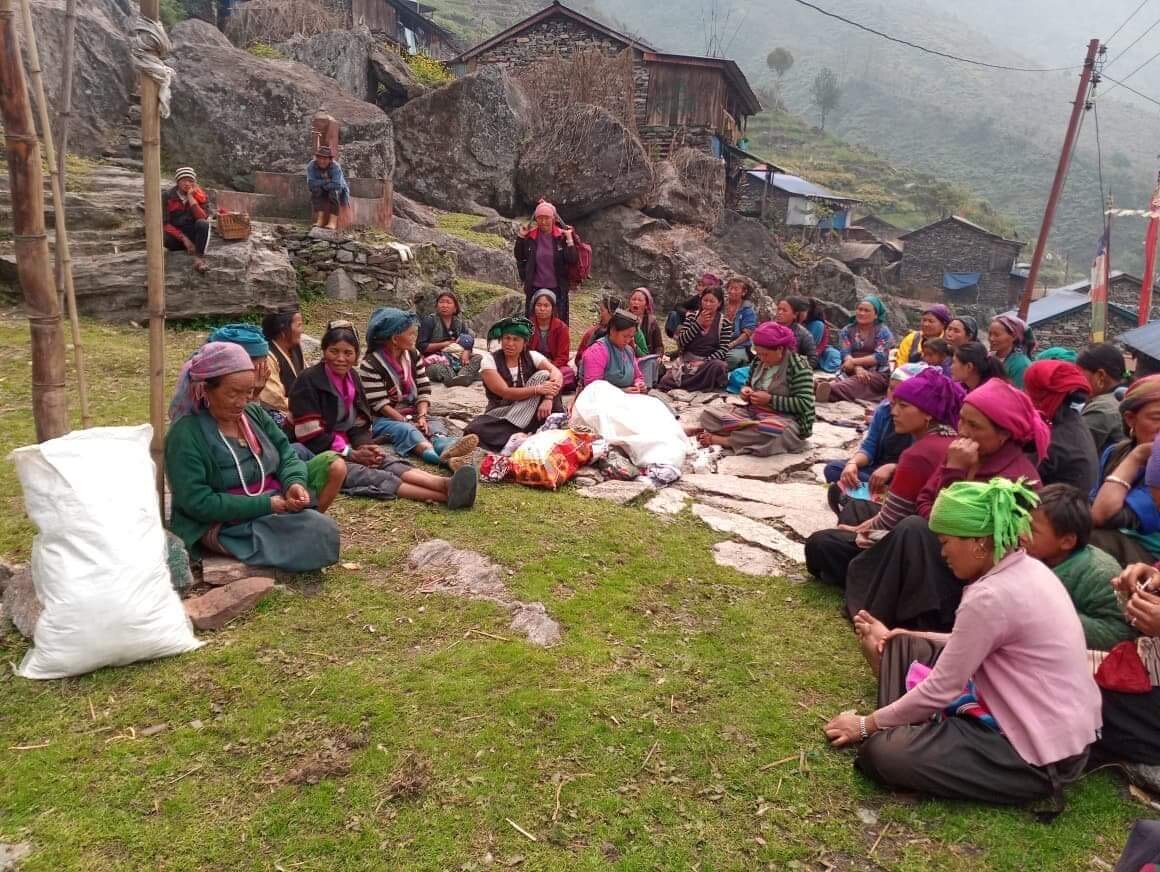
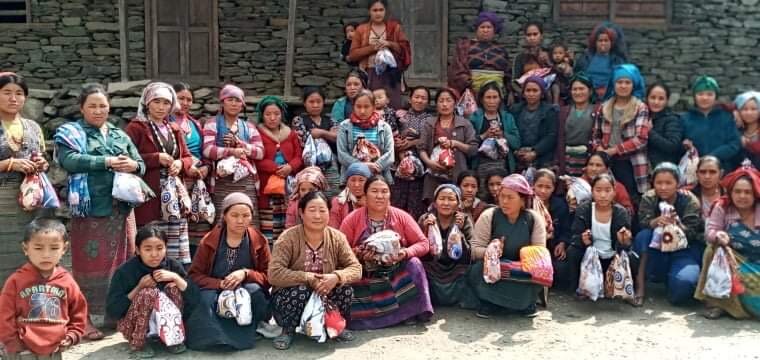
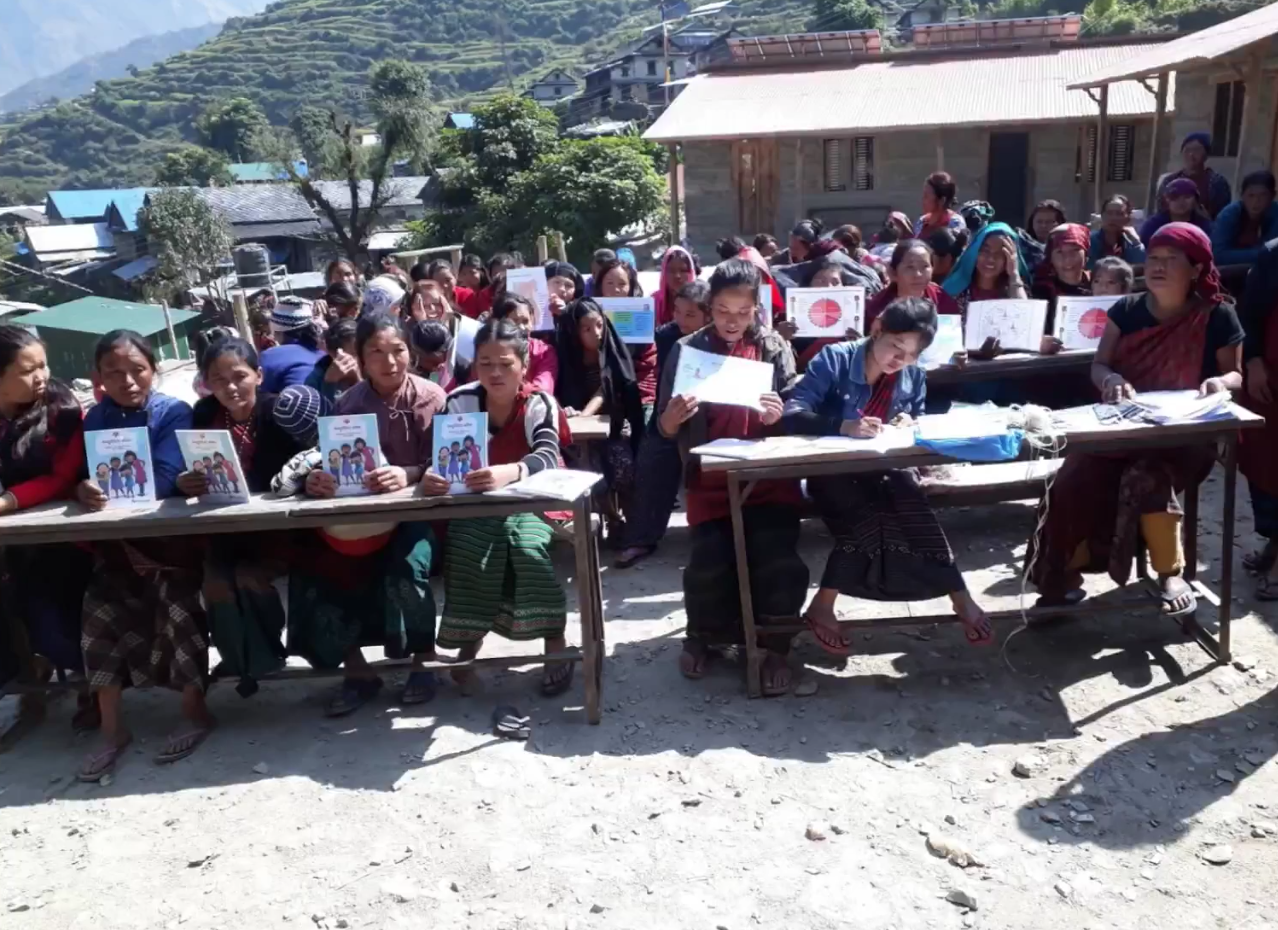
After attending our trainings, women returned to their own villages to conduct their own trainings and distribute menstrual kits we had supplied them with

Hiking past deep gorges descending through hardwood, conifer forests that weave through villages,  the word “Seva” comes to mind, Seva is the Sanskrit word for selfless service, a genuine compassion for others and a genuine desire to uplift those around you without expecting anything in return. I see this work as a Seva on both sides of the spectrum. We were receiving as much generosity, kindness and  knowledge from the Lhomi people as we were giving. Despite changes in our plans due to landslides, thunderstorms and road blasts, the locals were nonchalant about the external factors that they couldn’t possibly control. 

I feel that the essence of our trip was to learn to be in the ‘here and the now.’ I’m so grateful to have received this lesson from the Lhomi people, and I give thanks to everyone that believed in us and made this work of distributing pads and menstrual education to the Arun Valley possible,  

Want to support CCF’s Menstrual Health and Hygiene work in Nepal? Any amount makes an impact and helps empower girls and women. Hit the button below to donate. Thank you!

Donate

Hot Off the Press! CCF's Menstrual Health Guide

MHM_Guide_image.jpeg

by Colleen Cahill


Talk about a labor of love.

After nearly two and a half years of incubating...er...I mean, development, Conscious Connections Foundation (CCF) is proud to announce our brand new Guide to Menstrual Health for Women & Girls is complete and has already been put to use! This is BIG news for our small and mighty organization.

CCF super-hero-slash-key-partner, Kesang Yudron, led a massive effort to bring menstrual health training to the remote villages in the Upper Arun Valley in Eastern Nepal last month—our first training session since the lockdown began last year (look for this story coming soon). The women and community leaders loved the guide with all its bright and fun illustrations.

Puberty page layout

Puberty page layout

CCF Steps Up Menstrual Hygiene Management (MHM) Training Initiative

In the fall of 2018, CCF began conducting menstrual health training. This initiative grew out of our existing Power of 5 program working to educate children—with an emphasis on girls.

Through this effort to educate girls and break down cultural barriers, it was clear that without adding the menstrual health component, we’d be falling short on truly setting them up for success. It aligned well with CCF’s mission and Nepali partners led the way to get this work started.

Kesang Yudron, CCF MHM project manager, set out the goal of the initiative:

“To inform and provide access to information on Menstrual Health and Hygiene across Nepal so women have a choice to live in dignity, equality and justice.”

To date, CCF has held several trainings in Kathmandu as well as several remote areas, and until last month, there have been no specific course materials. The students and trainers asked for a more permanent and comprehensive reference tool to take home and share with others.

In doing some research to see if other organizations had an existing menstrual health manual CCF could purchase to support our training sessions, we discovered the options were proprietary and didn't quite fulfill our need for information that fit all literacy levels.

Kesang proposed to the board that the organization create its own manual and design it based on our specific training focusing on issues around gender inequality, sexual reproduction, myths, taboos and religious beliefs surrounding menstruation and the local laws that support women’s rights. She added that it should be available to anyone who wanted it so that it might be shared widely.

This was no small undertaking, but the board unanimously agreed to fund the project.

Kesang was off and running.

The “Un-Manual”

CCF formed a menstrual hygiene committee to offer support to Kesang as she gathered her team in Nepal and developed content. Together, we determined the primary goal of the manual—to simplify the menstrual health information so that students of all ages with different levels of literacy and education could understand it and get excited to share it back to their families and communities.

We wanted to avoid creating another boring textbook. To keep the students—whether female, male, young or old—engaged and curious, Kesang hired an illustrator to develop colorful, fun and informative illustrations. This talented Nepali woman, Promina Shrestha, brought the guide to life by introducing “The Egg,” our cute, friendly main character who shepherds us through the manual explaining diagrams and offering informative tips and encouragement.

Illustrator’s rough sketch of The Egg describing her journey through menstruation

Illustrator’s rough sketch of The Egg describing her journey through menstruation

For a topic in Nepal that can be taboo and shameful, this was an effective tactic to make students feel more at ease.

The team in Nepal was rounded out with help from a nurse, writer, translator, and graphic designer, with a little support from the menstrual hygiene committee stateside.

Illustrator’s rough sketch of The Egg explaining what might happen during menstruation

Illustrator’s rough sketch of The Egg explaining what might happen during menstruation

Comprehensive Menstrual Hygiene Content

This version of the guide is one CCF will continue to evolve going forward. Many issues were discussed and considered, but in the end, we focused in on the following outline for our first edition:

  • Puberty

  • Anatomy (male and female)

  • Menstruation

  • Menstrual Restriction, Social Norms and Taboos

  • Menstrual Products (Pros and Cons)

  • Menstruation and the Environment

  • Menopause

  • Menstrual Cycle Calendar ( Moon Cycle)

Menstruation page layout

Menstruation page layout

The Introduction invites the student in with a friendly tone and immediately frames menstruation in the positive light it deserves:

Menstruation is an exciting time of change in your body and mind that signals your entry into womanhood, sexual activity, and being able to have babies. Although it’s an exciting time of change and is a completely normal and healthy process, many girls face exclusion and restriction due to the belief that menstrual blood is impure and dirty. Chauppadi, one of the most restrictive menstrual practices of confining women in small sheds, is practiced in Nepal.

This mini manual is designed to explain to families and communities about Menstrual Health and Hygiene. This Menstrual Health Manual, explains the natural and normal changes that are happening in your body. When you are more knowledgeable about your body, you will be empowered and better equipped with the information and confidence necessary to manage your long-term sexual and reproductive health.

Maintaining good menstrual health starts with understanding the changes that occur in our body during puberty.

The manual even comes complete with a menstruation calendar at the back, so the women and girls have a tool to help them learn how to track their periods!

Spreading Menstrual education far and wide

CCF published the guide under the creative commons license. It is our hope that this information is shared out freely and widely throughout Nepal and wherever menstrual health education is needed.

The guide was produced and printed in both English and Nepali. If you’d like to support this work and menstrual hygiene education in Nepal, hit the button below. Just $20 sponsors a student to attend menstrual health training. Your dollars make a huge impact.


A BIG thank you to our donors! Through you, this work has been possible.

Donate

A CCF Year in Review: Building Community Resiliency During COVID-19

By Cameron Conner, CCF Vice-Chair

Of all the things that come to mind when I stop to reflect on this year we’ve had, I think more than anything about resiliency. People are tough, but it’s our relationships that make us that way. This year we’ve seen people demonstrate levels of collective courage like never before, marching for racial justice, voting in unprecedented numbers, buying groceries for at-risk neighbors, and creating community-wide mutual aid networks. The thing I love most about working with the Conscious Connections Foundation is that it’s our job to build the kind of relationships that allow this collective courage to grow; the kind of relationships that serve as a foundation for community resiliency. Our job is to bring people together and enable them to achieve, as a group, what no one individual could do on their own. The importance of this work becomes particularly pronounced in times of crisis. 

The Conscious Connections Foundation (CCF) was created to promote girls’ access to education and support rural healthcare, yet in our five short years of existence we have found ourselves at the heart of two distinct and historic disasters. The first was Nepal’s earthquake in 2015, and now it’s the Coronavirus pandemic. It was never our intention to be a disaster relief organization, but we’re playing the cards we’ve been dealt. 

Beginning in early April of this year, Nepal entered a complete lockdown for over 90 days. In quick order after that, it reopened, locked down again and is now once again open despite having record case numbers. Right now, cases are surging, and the Nepali government simply doesn’t have the resources needed to combat it on such a large scale. As in the United States, the virus is affecting those who are the most vulnerable: day laborers, widows, children, the elderly, and immigrants, among others. As starvation looms in many of these communities, the biggest threat is simply lack of money to buy essentials. 

Screen Shot 2020-12-22 at 8.53.23 AM.png

CCF’s philosophy has always been that we want to work ourselves out of a job; we want to build capacity in the communities we work with so that our presence is no longer needed. It’s all about cultivating community resiliency. Right now, this looks a little different than usual: the biggest barrier to girls attending school is COVID-19, and the biggest health crisis for many—alongside the Coronavirus—is hunger. The relationships we have, and the nature of our work means that if we want to continue pursuing our mission, we need to address these kinds of critical and emergent issues first.   

Over this last year, with the incredible support of our donors, CCF did just that. Our Nepali partners on the ground conducted emergency food distribution to some of the most vulnerable groups in the Kathmandu Valley. They also distributed 600+ reusable cotton menstrual pad kits along with hundreds of additional masks and bars of soap to women and girls who lacked the resources to purchase these supplies themselves. CCF accomplished all this while continuing to strengthen the infrastructure and resources of our Menstrual Pad Program, the Baseri Health Clinic, and the Girl Child Education Program. 

Fighting for women in two very different ways

Diya Maharjan was one of CCF’s three Joy Attwood Scholarship recipients in 2020. With it she will be able to continue her eduction and pursue her dreams of becoming an IT engineer.

Diya Maharjan was one of CCF’s three Joy Attwood Scholarship recipients in 2020. With it she will be able to continue her eduction and pursue her dreams of becoming an IT engineer.

Partnering with the Fatima Foundation, CCF distributed 500 Masks, 500 Soaps and 300 reusable Menstrual Pad kits to a group working to protect the human rights of poor Muslim and Madhesi women and children in Nepalgunj.

Partnering with the Fatima Foundation, CCF distributed 500 Masks, 500 Soaps and 300 reusable Menstrual Pad kits to a group working to protect the human rights of poor Muslim and Madhesi women and children in Nepalgunj.

On top of providing emergency relief for individuals and families, one of the largest unanticipated challenges we had to confront was the overwhelming burden placed on some of our organizational partners in Nepal. With no financial aid coming from the government, and traditional income channels shut off due to lockdowns, groups like TEAM Nepal and the Association for Craft Producers—whom CCF has partnered with for years—were on the brink of collapse. These groups have served some of the most marginalized Nepali communities for decades. If they failed, we knew those years of knowledge, experience, and organizational credibility would be lost with them. To prevent this from happening, CCF has so far provided nearly $50,000 to help these groups sustain their basic operating expenses—our own version of a PPP loan. Read more about this story here.

At times heartbreaking, this work has also offered us a unique glimpse into many amazing moments as well. When traditional support systems fail and people lack any other options, we have seen how time and again people turn to one another as a source of support and safety. In the U.S. when this phenomenon started cropping up, it was called “mutual aid.” People helping people for no personal gain, just generosity and reciprocity. In Nepal, folks have been doing this kind of thing since long before the pandemic began; they are lightyears ahead. Thanks to our incredible volunteers over there, we were able to tap into these networks and work directly with the people.

CCF owes great thanks to Kesang Yudron, Pema-la Lama, and Chunta Nepali in particular. These amazing women are true heroines. Drawing on their own personal networks to pinpoint need early in the crisis, they initially collected, organized, and distributed food to 62 families who were unable to afford it because of reliance on day labor wages. These were the families of rickshaw drivers, widows, builders and street vendors. Since then, Kesang, Pemala, and Chunta have grown their distribution channels to different groups as their networks expanded. You can read Kesang’s insightful blogpost about their experience here: Humanitarian Efforts in Nepal Prove Challenging

Left to right: Kesang Yudron, Pemala Lama, aKesang’s sister Chimme Dolkar

Left to right: Kesang Yudron, Pemala Lama, and Kesang’s sister Chimme Dolkar

CCF’s other amazing partner, Chunta Nepali

CCF’s other amazing partner, Chunta Nepali

We’ve certainly learned a lot from this year, and we will go forward stronger because of it. But I also want to recognize that our ability to go forward at all is due to the incredible support of so many others. So, as we round out 2020, “the year of perfect vision,” I want to end it on a personal note of gratitude for the relationships that have made us resilient. 

First and foremost, I want to give thanks to all of our incredible partners on the ground in Nepal, who helped us roll with the punches and kept us constantly busy doing what CCF was made to do. To Pampha in Ghat Besi, who helps oversee our scholarship program; to Ram and Pradeep Karki, our constant guides and emergency organizers; to Meera, Revita, Prashtuti, and the entire team at ACP, who have carried on the Power of 5 and Joy Attwood scholarship programs even as the rest of their world threatened to fall apart; and to so many others. CCF has remained nimble and been able to adapt during these crazy times only because we work with such thoughtful, kind and courageous people. 

I want to give thanks to our volunteers in the United States: Fred Peck for his constant and extremely patient financial expertise; all those who found a Corona-safe way to participate in our annual Run for Her Life fundraiser; Sarah Conover for her hours of help editing the Menstrual Health Manual. Thanks to CCFs incredible board of directors who pour their own expertise and energy into this work for the sheer love of it. CCF is able to put nearly 99% of its donations towards programs because Board members take on the day to day responsibility of running the organization, refusing to let Covid, Chemo treatments, or babies get in their way. This is a huge amount of work, yet somehow folks still find the time to show up and get it done. I could not ask for a better team to be a part of. 

And last but not least, I have to thank our donors, without whom this work would not be possible. You are the fuel that keeps our engine running! We can't thank you enough for your incredible generosity. 

For more stories about our work, stay connected and visit the CCF website, as well as Conscious Connections Facebook page to stay informed. If you know of others who would like to support this kind of work in Nepal, we would love it if you shared this with them. We are SO GRATEFUL for everything you have done to sustain CCF. Your continued support has been a huge inspiration and believe me, it changed lives. 

Stay safe and well! YOU ARE AMAZING!!! 


Cameron N. Conner 


CCF Helps the Association of Craft Producers Survive COVID

By Denise Attwood, CCF Chair

Artisans of ACP

Artisans of ACP

Recently I was contacted by my dear friend, Meera Bhatterai, director and founder of the Association for Craft Producers (ACP), regarding a truly perilous situation for over 1000 women artisans in Nepal. ACP is a Nepali non-profit, fair trade organization providing design, marketing, management, and technical services to low-income Nepali craft producers. Their focus is to not only employ women but to also provide fair wages and social benefit programs. It is this package that is helping their women producers thrive and transcend cultural barriers. The impact of ACP is extensive and has empowered 1000s of women across Nepal since their founding in 1984.

For these numerous women, working with ACP has meant:

  • Gaining control of the money they earn for the first time in their lives. This control has earned them greater respect and given them greater decision making power in their families and communities helping them break the constraints of a patriarchal society,

  • Being able to send their children, especially daughters, to school. Most producers at ACP were denied education as children due to poverty and cultural constraints. Now, financially stable and with assistance from ACP & CCF through the Power of 5 & Joy Attwood Scholarship, many are able to send their children, especially daughters to school and even on to college, breaking down the cycle of generational poverty,

  • Being able to work in healthy, clean spaces. Working conditions in Nepal are often poor, lacking proper ventilation, with leaking roofs and rough mud floors. Projects led by ACP have changed workshops into healthier, cleaner spaces. These changes have affected the health, productivity and morale of ACP’s producers and has given them a greater sense of self respect.  

  • Being able to do things many of us take for granted like visiting a doctor, learning about their constitutional rights or having their own bank account.  ACP prides itself on providing these benefits and more to all producers.  For these Nepali families, access to medical stipends, health and dental camps, interest bearing savings accounts, and retirement, is life changing.

ACP is a founding member of the Fair Trade Group Nepal and a long-time member of the World Fair Trade Organization. They are a Fair Trade success story. I have been working alongside Meera and ACP since 1986 as a fair trade business owner. Our relationship has strengthened over the years, enduring civil war, natural disasters, and economic insecurity. Throughout all of this, ACP and my business, Ganesh Himal Trading, have always attempted to ensure our efforts go beyond business to benefit everyone involved, in every aspect of their life. It was largely these efforts that led to the formation of CCF in 2014.

Donate to ACP
Meera & Denise in 1986

Meera & Denise in 1986

It is because of this long standing relationship that ACP is one of CCF’s greatest partners in Nepal. 

  • CCF partners directly with ACP to keep over 100 children (with an emphasis on girls) in school each year through the Power of 5 program.  It was through their recommendation that CCF has been working towards creating an endowment for the program that will ensure access to primary level education for producers’ children for generations to come. 

  • CCF partners with ACP to provide the Joy Attwood College Scholarship—giving three girls who have need, ability and desire, a means to continue their education into the 11th and 12th class. 

  • CCF partners with ACP to employ the Girls’ Education Program Administrator who oversees the administrative and reporting requirements of these programs while also serving as a mentor and counselor for the recipients.   

  • CCF partnered with ACP after the 2015 earthquakes to ensure women were able to begin earning consistent incomes as quickly as possible to help with recovery.  This partnership led to the rebuilding of the Kirtipur weaving workshop

Donate to ACP
The Kirtipur weaving group outside their newly completed community weaving facility.

The Kirtipur weaving group outside their newly completed community weaving facility.

Now, however, with the lockdown due to Covid-19 and the subsequent loss of sales, ACP’s situation is dire and they have reached out for help. There is no PPP loan in Nepal nor are there government resources for those who have lost their employment. ACP’s expenses for salaries and benefits alone, comes to $33,000/month so you can see that they will need a lot to cover the producers’ wages in the coming months. With sales at 40% less than previous years and orders to make they need capital to survive while they learn how to adapt.

In early July, CCF was thrilled to be able to provide a $25,000 grant for ACP’s operating expenses but they need much more than that and so we are looking to raise at least $25,000 more on their behalf. Because CCF is an all-volunteer run non-profit with grants to cover bank and administrative fees, we can ensure that 100% of your donations for this incredible organization will go directly to ACP. My husband, Ric, and I will personally match the first $2500 of donations made to assist ACP.

DONATE TO ACP

As Meera so aptly states in her letter:

ACP has been self-reliant since our establishment in 1984, as a Not-for-Profit social enterprise, ACP had become self-sufficient from the 4th year…it has been 30 years since ACP has relied on its own income source for day-to-day operations. In 2015 after the devastating earthquake, we had a very fragile financial situation and we sought donor support to meet our operational expenses. We once again face a difficult situation. We are in dire need of working capital to tide over the present grave crisis imposed upon us by the pandemic. Sadly nothing significant has been announced by the government which would benefit MSMEs and SMEs like us. We are trying to locate funding support for our operational cost for the next 6 months, amounting to NRs. 30,000,000 (USD 260,000). You have always believed in our work and supported us in time of crisis. We once again seek your support…We thank you for your continued support and looking forward to your response.

Take care and stay safe.

Warm regards,

Meera

Denise & Meera in 2013

Denise & Meera in 2013

CCF believes that when women and girls thrive, the world is better off. Our mission is to support women and girls in Nepal becoming key participants in healthy societies, partners like ACP allow this work to happen. ACP is an amazing group, with a long history of bringing income and resources directly to women, they cannot fail and we hope you can help them in this time of need in any amount possible.

DONATE TO ACP

A Snapshot of the Effects of the Corona Virus pandemic in Nepal and CCF’s Emergency Relief Response

By Golie Jansen, Board Member

Homeless woman in Dhobichaur receiving CCF COVID-19 food relief

Homeless woman in Dhobichaur receiving CCF COVID-19 food relief

Introduction

I am a relatively new board member of the Conscious Connection Foundation, although I have known about and followed their work for a long time. I have always been impressed by CCF’s philosophy of capacity building, especially with women and girls. Most of the programs of CCF are long term, and build upon work in Nepal over the last 30 years. 

At one of our last board meetings in June, our partner in Nepal, Kesang Yudron, in Kathmandu wrote us an overview of the effects of the new coronavirus pandemic in Nepal: no fertilizers, vegetable shortages, mass return of migrant workers, suicides rising, problems with testing, day laborers out of work, diseases, deaths and hunger, and more hunger among the most vulnerable populations!

It affected me more than I thought it would, perhaps because I realized the poorest of the poor are always immediately the hardest hit. I also sadly realized that Nepal is only one country of many in the world that is going through such hardships. 

CCF’s goal is to create resilient communities in Nepal by empowering women through education and healthcare. But, as it was after the 2015 earthquake and now with the COVID-19 pandemic, CCF once again finds itself in a unique position to step up and take action in the face of overwhelming odds. Because of our strong community of support in the United States, and because we have a dedicated team of young Nepali leaders ready to take on the challenge, we at CCF have decided to start fundraising for emergency relief once again. I am writing this blog in the hope that you, like me, will donate to this effort.

Like the rest of the world, Nepal has suffered tragically from the COVID-19 pandemic. As of July 20, there were 17,844 confirmed COVID-19 cases. Since April, CCF has been closely involved with helping to alleviate the need for food for vulnerable groups of people most affected.

This blog will highlight some of the most distressing consequences of the COVID-19 pandemic, but it is by no means complete. After a general overview and some specific topics, it will describe the ways CCF has helped identify and fund locally led efforts to help some of the most vulnerable and least visible communities in different parts of Nepal. 

Overview

The government of Nepal announced a country-wide lockdown on March 24 to limit the increase of COVID-19 infections. This brought great hardship to the most vulnerable, especially women and children. Many hold day jobs, and immediately lost pay, while remittances from relatives in India and the Middle East also stopped. The lockdown was eased on June 14, which resulted in an enormous movement of people across the country and a large spike in COVID-19 cases. Kesang Yudron wrote on July 3 in one of her emails:

“There is a partial lockdown till July 28, which will probably be extended with 400-500 new COVID-19 cases every day. Schools are still shut and the government does not have a definite plan when schools will open. Thousands of people from taxi drivers to youth groups are protesting on the streets to be allowed to work and wanting more PCR testing and an effective COVID-19 plan. Up until now there are more people dying of suicide and hunger than COVID-19 related deaths.” 

 Members of youth groups in Kathmandu, have protested, demanding better quarantine facilities, more testing and greater transparency in purchasing medical supplies (The Hindu, June 13, 2020).

Return of Migrant Workers from India and the Middle East

About 3.5 million Nepalis work and live abroad. Of these, about 2 million work in India and others in 14 countries in the Gulf countries (e.g. Bahrain, The United Arab Emirates, Saudi Arabia, Qatar and Oman). Many also work in Malaysia. It is reported that in Qatar alone, 400,000 Nepalese migrant workers live and work mainly in construction and as domestic laborers. Unlike France and the UK, Nepal did not send planes to bring workers home, and has only recently started to repatriate them.

Many poor Nepali families rely on remittances. More than $8.1 billion remittances are sent home, contributing close to 25% percent of the country's $30 billion gross domestic product (GDP). Nepal is the fifth highest remittance country in the world.

When India announced a strict lockdown on March 25, many Nepalese workers on work visas there lost their jobs. Approximately 580,000 Nepalis stranded in India are returning home. Some walked for days to find a bus, van, or truck to get to the border. Many found informal channels to enter the country. Nepal closed the border with India on March 22, and only in late May were people allowed to cross. The situation is dire at many border crossings. At some crossings, 2,000 people arrive every day, often without food and water after having traveled for days in India. They are regularly denied any relief. After being held in quarantine centers on the border in horrendous conditions and long waits for results of testing, these workers are then transported to their home districts, where they are quarantined in camps in unhealthy conditions, with no, or scant, basic services like food, water, toilets or medical care.

Complications with Testing 

Nepal has been plagued by substandard testing, which may have increased the infection rates. The majority of tests for the new coronavirus throughout Nepal have been Rapid Diagnostic Tests (RDT).  So far, over 233,000 RDT tests have been conducted to detect antibodies. The Nepal Health Research Council found RDT tests only reliable 50% of the time. This might mean that thousands of people sent home from quarantine could have had false results. The World Health Organization does not recommend the use of rapid diagnostic tests for patient care.

PCR (Polymerase Chain Reaction) tests are more reliable, but the test kits supplied by the Ministry of Health and Population are incompatible with the testing machines in different labs in the country. Many PCR hospital labs had to close, which delayed testing of thousands of people. People in quarantine facilities in Rautahat waged a protest against delays of a week or longer to receive PCR test results. They blocked roads and threw stones at security personnel. Police fired in the air and used dozens of rounds of tear gas.

Daily wage workers are more worried about starving to death than Covid-19

Many poor people are daily wage workers, who have lost their job and therefore face enormous hardships. Their living environments do not facilitate conditions that minimize transmission of the virus. They live in cramped squatter settlements, where many households share water taps and toilets, which increases the chance of infections. Remaining indoors as the lockdown mandates is impossible, due to the heat in the shacks they live in. In Kathmandu alone, there are around 29,000 squatters faced with this new reality. One of the daily wage workers stated: “Rich people have managed to store food and can now spend some time at home with their families. It’s like a vacation for them. But for working class people like us, if this situation prolongs, we will die of hunger.” (Kathmandu Post, 3-30-2020). The government so far does not seem to have a plan to support these workers.

Economy and Employment

After the earthquake of 2015, Nepal planned to achieve a growth of 9.6% (The Diplomat, 4-15- 2020). However, the latest projections (Kathmandu Post, 5-3-2020) are that GDP will fall to 2.3 %—much lower than the 7.2% that was achieved pre-COVID-19. This contraction has affected mostly migrant workers and the poor. Nepal’s estimated unemployment rate is currently 11.4%. The influx of millions of migrant workers back to their villages without money, food or employment, and the loss of employment of resident Nepalis, could cause a severe economic downturn. A World Bank country economist for Nepal stated: “About 31.2% of the population estimated to live just above the poverty line risk falling into extreme poverty, primarily due to lower remittances, foregone earning of potential migrants, job losses in the informal sector, and higher prices for essential commodities due to the lockdown.” (Al Jazeera, 6-9-2020)

 
The main tourist road in KTM lies empty during COVID-19.

The main tourist road in KTM lies empty during COVID-19.

Agriculture

Before the COVID-19 pandemic agricultural output was already threatened by a late monsoon, shortage of fertilizers, and use of substandard seeds. The pandemic has only exacerbated this situation. Fertilizers needed for rice paddy plantations have been stuck in India for months. Vegetable shortages in the mid-hill districts have hiked the prices between 30-60% since lockdown. 

Mental Health: Suicides

People who experience mental health problems in Nepal are often stigmatized, therefore people may not share their problems, and suicide becomes their ultimate solution. The impact of the COVID-19 pandemic has increased mental health concerns as people experience more anxiety and depression about job losses, fear of getting the virus, and lack of food. Children are home from school and living conditions for many families are less than adequate. Since the nationwide lockdown, suicide cases in Nepal increased by 20% and mental health experts warn of a “grim situation.” In the first month of the lockdown, a total of 487 people died by suicide as compared with 400 per month before the lockdown (Republica, May 21,2020).

Poor Women are the Most Vulnerable

CCF COVID-19 food recipient in Saptari Nepal

CCF COVID-19 food recipient in Saptari Nepal

Women disproportionately suffer the consequences of the pandemic. Luna K.C., an independent Nepali researcher warns that the pandemic will worsen existing inequality of women in education, income and employment. COVID-19 has eliminated many jobs mainly filled by women, creating economic insecurity, while many may not regain their jobs after the pandemic is over, as finding work is harder for women than for men. In terms of education, the COVID-19 crisis may cause a higher drop-out rate for girls, who may not return to school afterwards. 

CCF’s Approach to Helping the Most Vulnerable: Immediate Food Relief

Nepal's situation in light of the COVID-19 pandemic is incredibly difficult and filled with huge uncertainty. CCF recognizes the immensity of the challenge and understands that although we are small, we have such good contacts that we have to respond in order to relieve what suffering we can.

CCF's work centers on women and girls and the most marginalized in Nepal and is based in long-term trusted relationships. That is what makes us so effective. In early April, our partner, Kesang Yudron, reached out and identified contacts with local Nepali-led NGO’s that were truly helping women & children and marginalized communities in desperate need. Consequently, as soon as Nepal mandated a lockdown, Kesang received many requests from NGO’s to help with food relief.

Lacking Government Support

As of the writing of this blog, no government food relief is happening anymore. From April through June, with Kesang’s guidance, CCF was able to distribute $5000 to small local NGOs to be used directly for immediate food relief. We also were able to deliver 400 reusable menstrual kits, soap, and masks to women who needed them but could not afford them. Although our reach is not huge, our impact has been targeted and effective, helping those who would otherwise fall through the cracks survive.

CCF Response

Two Food Relief Distributions in Saptari

On May 30 and again in June, Kesang was able to connect with a leader of a local NGO in Saptari, Nepal, along the border of India. With CCF funds, the NGO was able to purchase and distribute 25kg of rice, 3 kg of dal and salt to 41 households. All of these families were facing starvation and in the words of one of the organizers of this food distribution “CCF has helped people saved from hunger.”

CCF was able to provide a second grant in June to help provide food for 1300 Mushar families (our grant was combined with others) who have been discriminated against for centuries and are considered the lowest caste of the Dalit groups in Nepal. Many of these families are led by women who have no land and whose husbands work abroad in India as day laborers and so have no income to send.

The Hiteri Foundation

Distributing food and reusable menstrual kits (faces blurred by request)

Distributing food and reusable menstrual kits (faces blurred by request)

The Hiteri Foundation has been actively distributing food to those in dire need since the lockdown started. CCF, through Kesang, initially funded the distribution of enough food for two weeks to 30 families who had no resources. When it was discovered that women and girls were also in need of menstrual supplies, CCF donated 200 kits that had already been made for our Menstrual Hygiene training program (which is in a holding pattern due to the pandemic), so that women would not have to worry about their periods. Since the initial donation to Hiteri, CCF has donated more funding, and with combined donations, Hiteri was able to provide food and menstrual supplies for 120 families in need at the Jana Uddhar Secondary School in Bunahilkantha. We have also funded the production of Nepali made masks and soap for these families and those are being distributed with the food and menstrual supplies.

Aid to Day Laborers in Dhobichaur Municipalities

Dhobichaur COVID-19 Relief Food distribution

Dhobichaur COVID-19 Relief Food distribution

Kesang, Pemala, Chunta and crew were able to purchase food wholesale and are true heroines! They bagged up and distributed food to 62 families who had run out of food because they rely on day labor wages. The family of rickshaw drivers, widows and many others were so grateful for their heroic efforts. They learned a lot and became connected with the municipal authorities so that they can do more in the future and be even more effective.

Fatima Foundation

CCF’s most recent contribution was to the Fatima Foundation in Nepal. Kesang connected with the founder of this group, Muhammadi Saddiqui, who has been working to protect Muslim and Madeshi women and children’s human rights in Southern Nepal through her foundation. She has been conducting programs on domestic violence as well as providing women with education and skills training. With CCF’s funding they were able to provide COVID-19 food relief to 91 of these women and their families because they are in desperate need and have few resources.

CCF COVID-19 Food Distribution in Partnership Mitini Nepalgunj, June 2020

In June, CCF also partnered with Mitini, a prominent Nepali NGO that works with the LBGTQ community in Kathmandu. Because transgender communities, in particular, already face severe social discrimination before the pandemic, they have been disproportionately affected by COVID-19, falling through the cracks of whatever aid is earmarked for the general public. A group of 30 trans women reached out to CCF directly sharing that they had access to some food, but lacked the funds to buy cooking oil. With the support of CCF, $12.80 per person was spent to buy this necessary supplement for these women. They were extremely relieved to be able to cook meals and all expressed interest in continuing this partnership into the future.

Because transgender communities are often among the most vulnerable and marginalized, these women have requested we not show their photographs. 

Call to Action

We all have a responsibility to understand how this pandemic affects the most vulnerable in our society and around the world. There are many parallel circumstances in the US and Nepal as a result of the coronavirus pandemic. Like in Nepal, many people in the US who are disenfranchised and live on the margins of society—living paycheck to paycheck, suffering from poverty, from job loss, lack of adequate health care, homelessness, chronic disease, etc.—are falling through the cracks. The Providence Organization estimates that the number of households affected by food insecurity in the US has doubled since the pandemic started and that over 34 percent of households with a child 18 and under are food insecure. Everyone has watched television scenes of enormously long lines of cars waiting to receive food from a food bank. The suffering among those affected is high.

 Additionally, the US government has passed a relief program, the Paycheck Protection Program, that has made it possible, especially for small businesses to receive bank loans with the goal not to fire employees. Further unemployment benefits ($600) for a limited time were available for many workers, including gig workers, and a direct payment of $1,200 to individuals under a certain income level, helped many people to lessen the impact of the coronavirus.

None of these supports have been available to people in need in Nepal. We all have to reach out where we can. CCF, at this moment is well poised to do effective relief work in Nepal and so that is what we will do. We can feed a family of four for a month on about $30. It doesn’t take much, but it will help us all through these hard times. The need for food relief for the most vulnerable in Nepal is urgent and we hope that you find it in your heart to make a generous donation!

With thanks to Kesang Yudron for providing most of the resources, and Peter Gill for checking accuracy, Sarah Conover for editing, and Denise Attwood for much information and insight.


Supporting Girls’ Leadership in Nepal

By Martha Newell, Board Member

CCF Board Member Martha Newell interviews Women LEAD Alumn Reeti KC in 2015

CCF Board Member Martha Newell interviews Women LEAD Alumna Reeti KC in 2015

Reeti Before

Reeti KC was a self-described “overweight teenager” who found her self esteem plunging in her teen years because she didn’t believe she was beautiful. One day, some very articulate, self-confident young women spoke at her school about a program they had completed through Women LEAD. Reeti wanted to be confident like them so she applied to join the program they described. 

Reeti credits her participation in Women LEAD’s yearlong program in helping her identify her passion. The first two-week leadership course introduced her to skills such as self-defense, public speaking, and negotiation, as well as topics like identity, media and gender stereotypes. When she learned about media stereotypes, she realized her self-hatred was fueled by the media saying her body type was not beautiful and that she and the people around her had all bought into that stereotype. That realization changed her life. Her goal quickly became to eradicate these stereotypes and celebrate all body types. Five years after beginning the Women LEAD program, she graduated with a degree in Media Studies.

Reeti and CCF partner Revita Shrestha at the International Women’s Day program for CCF’s Power of 5 scholarship recipients

Reeti and CCF partner Revita Shrestha at the International Women’s Day program for CCF’s Power of 5 scholarship recipients

Before some of the CCF board went to Nepal in Feb 2015, I learned of Women LEAD from a colleague. Women LEAD put us in touch with Reeti to speak at an International Women’s Day program for CCF’s Power of 5 scholarship recipients. Reeti had completed most of her year in the Women LEAD course by then. We were impressed by what a strong confident speech she gave and how she inspired the Power of 5 recipients to want to be a part of Women LEAD. After she spoke I was lucky enough to interview Reeti to learn more about her experience with Women LEAD. Reeti said it was her first public speech since 9th grade when she “ran away from the stage due to stage fright.” It was tangible evidence of how much she had changed over the one-year course. 

We at CCF have stayed in touch with Women LEAD and helped build awareness of their programming to the scholarship recipients of our Power of 5 program. This year, CCF has provided our second grant to Women LEAD to support the yearlong LEAD course which changed Reeti’s life. We are in complete alignment with Women LEAD’s goal to empower adolescent girls with the skills, networks and experience they need to become future change-makers in their schools and communities. The LEAD course enrolls girls ages 16-18 who are in their final year of high school. It is a very competitive process to be chosen for the program. Women LEAD has received as many as 300 applications/year and they enroll 30 girls annually. They are very committed to enrolling a diverse group of girls, coming from different ethnic, religious and caste backgrounds as well as those attending private and public schools. Women LEAD provides monthly stipends and English language classes to girls from marginalized backgrounds so they may fully and equally participate.

The LEAD course focuses on the three complementary approaches of identity, community and leadership. As the girls explore their values and strengths, and start self-identifying as leaders in a patriarchal society, it starts shifting paradigms and stereotypes. In addition, the LEAD course provides a safe space for the participants to explore ideas and identity and connects them with a growing community of other young women who share their vision. The young women are also given responsibility to run their own projects, giving them important leadership experience being role models, strengthening their skills and linking them to larger networks.

The initial program is a two-week Leadership Institute in which Reeti found her passion. During those two weeks, the girls gain critical knowledge and skills in teamwork, leadership, communication, management and public speaking. They also learn from guest speakers about contemporary issues including women’s political participation, civic engagement and women’s rights. There is plenty of time for self-reflection built in for the LEADers to absorb and reflect on all they have learned.

After the Leadership Institute, each LEADer is paired with a mentor (a LEAD course alumna) for the remainder of the year. The mentor provides guidance and support, helping the LEADer transition from high school to university. They are in touch online on a weekly basis, participate together in periodic mentoring events run by Women LEAD as well as independently meeting in person on a regular basis. This relationship is key to the success of each LEADer, as she receives constant encouragement and help to keep her focused on the goals she set during the Leadership Institute.

Paying It Forward: School Leadership Program

Power and 5 and Joy Attwood Scholarship recipients Heema Maharjan and Sanjana Shrestha

Power and 5 and Joy Attwood Scholarship recipients Heema Maharjan and Sanjana Shrestha

During 4 months of the program, each LEADer participates in the School Leadership Program (SLP). Pairs of LEADers establish a formal partnership with a middle school of their choice. After many more trainings at the Women LEAD office (150+ hours), the LEADers plan and lead 15 weekly sessions to share much of what they have learned at their middle school with 20-25 students, girls and boys, ages 14-15. The LEADers provide mentoring to the SLP participants, creating a huge ripple effect from the program. The LEADers are clearly kept busy through their participation in this program. In addition to the Leadership Institute, the School Leadership Program and communication with their mentors, the LEADers also attend more than 20 bi-monthly trainings and field trips. They also do advocacy activities throughout the year on issues they are passionate about like street harassment and menstrual taboos.

In their final month of the program, the LEADers focus on professional development trainings including resume writing, networking, and interviewing. They can also participate in summer internships to gain critical hands-on professional experience.

The LEADers enjoy a graduation together to celebrate their growth and accomplishments where they each offer a performance or speech and peer-nominated awards are given out for the LEADer who is most committed, who grew the most and who is the best role model.

CCF exists to promote work like Women LEAD's, believing in their goals to empower adolescent girls with the skills, networks and experience they need to become future change-makers in their schools and communities.

Pandemic Adjustments

Like the rest of the world, Nepal has been affected by the COVID 19 pandemic. Fortunately, the 2019-2020 LEADers had just finished their School Leadership Program before the Nepali government instituted a country-wide lockdown on March 24. The country is currently undergoing a gradual reopening, though that process is subject to change as new cases spike.

After the School Leadership Program ends, the LEADers have 2 months off from the program to prepare for their Board Exams. Though Women LEAD hoped they could conduct the final trainings and events in person, they have had to move their activities online.  June brings a week of online advocacy training, a week of online advocacy projects and 2 weeks of online Professional Development Training, followed by a virtual graduation ceremony.

The 2020-2021 LEAD course recruiting has had to be done online rather than in person through self-assured young LEADer alumni speaking at schools, as was the case when Reeti was inspired to apply to the program. The two-week Leadership Institute is scheduled to begin in early September, with hopes that it will be in person. Time will tell if they will be able to conduct the School Leadership Program those hopes will be realized. 


Reeti Now

After Reeti completed her year in the LEAD program, she went on to be a mentor to LEADers for the next two years. Her mentees came to her for advice about both professional and personal problems. After this long and influential relationship, one of her mentees even followed her to university in pursuit of a Media Studies degree!

Reeti’s interest in gender and media stereotypes has endured and she is currently planning to attend a graduate program in Gender and Women’s Studies in the US or elsewhere. Due to the Nepali academic calendar being different from other parts of the world, she has had to take a year off from formal schooling and hopes to take the GRE in October and begin grad school in fall 2021. In the meantime, Reeti is very excited to report that she just started a 3 month long contract with a non governmental organization (NGO) known as Her Turn. She says Her Turn works to empower girls and equip them with skills and knowledge for a safe and healthy future through various programs including a four week workshop for adolescent girls (12-16 years). http://www.her-turn.org/

IMG_20181208_210828_328.jpg

In reflecting on how her life would be different if she had not joined Women LEAD, Reeti thinks she might have studied Sociology or Social Work which was her plan before she joined the LEAD program. She says:

“I would have been passive to participate and bring my voice forth in academic or professional environment.

In terms of personal growth, I would be cocooned in self hate, self doubt and lack of confidence. Before Women LEAD, I never thought I could do something and achieve something. I did not believe in myself because there was no one to believe in me. In Women LEAD, I created a motto for myself, "Believe in the belief of believing in yourself", because that was where I learned the power of believing. If I was not a part of Women LEAD, I do not think I would have believed in myself.

Yes, I do acknowledge the possibility of personal growth even if Women LEAD was not a part of my life but I would not have been open to opportunities or build the strength to dive in and have the confidence to know I would be able to do it.“

I can’t think of a better testimony for the LEAD program than Reeti’s words. In a patriarchal world where men are in charge, and women and girls are systemically undervalued, we at the Conscious Connections Foundation are proud to support the work of Women LEAD. Empowering girls and women has been a driving part of our mission from the beginning. We know that increasing the number of women leaders has the potential to create long lasting, profound change not only in these local Nepali communities, but across the Himalayas and around the world. Amidst the challenges and changes of our current times, we need these leaders now more than ever.

In honor of Menstrual Hygiene Day, CCF highlights the work of Nepali partner, Kesang Yudron

By Colleen Cahill, Board Member

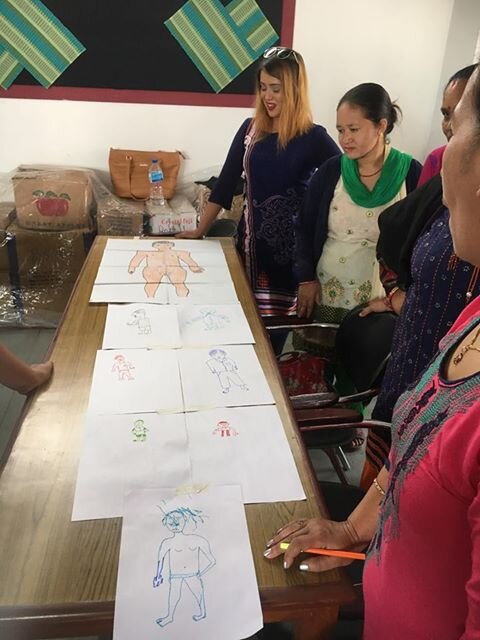
Photos: left to right; Women attend Menstrual Health Training in Sindupalchowk, Nepal; Pema Tamang teaching Menstrual Hygiene in Neber; Women learn about their bodies during a leadership training in Kathmandu


I got my period when I was ten. I can remember my mom had this big smile on her face and how excited she was for me. I, on the other hand, was mortified and did not share her enthusiasm. My “Aunt Flow” has faithfully visited once a month for 34 years now and amazingly, her timing is always perfectly inconvenient.

For most of my life, I viewed menstruation as just a part of life and didn’t think much about it beyond that—until four years ago. The advertising agency I worked for took on a pro bono project to help an underfunded program bring awareness to menstruation issues in developing countries—specifically Africa. My eyes were opened.

In a different country, with different everything, having a period can become a major obstacle for women and girls. Unfortunately, this holds true for many in Nepal. Cultural, environmental and economic issues can get in the way of girls and women rising to their potential and living lives free of restriction.

With the help of Kesang Yudron, CCF has developed a very active Menstrual Hygiene Program. She serves as Program Manager in Kathmandu, Nepal. In honor of Menstrual Hygiene Day, we wanted to help our donors get to know Kesang better and go a bit deeper to understand what inspires her to do this work.

But first, since I told my period story, I asked Kesang if she would share hers. She graciously agreed saying hers was “fairly normal.” She attended boarding school in India where she had a safe place to talk about periods and pads were available at a nearby store. She was 14 when her “Aunt Flow” first came to visit.

She also dealt with the same challenges most girls face—getting teased and feeling embarrassed or shunned when she stained her clothes.

From a cultural standpoint, growing up with Tibetan Buddhist parents—who held a progressive outlook—Kesang had more freedoms than many in her country. Her mom was always very supportive, with one exception of not being allowed in the prayer room during menstruation. Her belief is that the Gods will get sick.

Kesang’s story varies widely from others in Nepal where it’s a common belief that a woman’s period is impure. Kesang says “this belief is manifested in different restrictive forms from not being allowed to go to your kitchen to not being allowed to go to places of worship. In many villages, women can’t touch flowers because of the belief it will cause wilting or if they touch a cow, their teeth will fall off. The list goes on and on.” She sees the perpetuation of these superstitions as society’s attempt to control women.

She continues, touching on the issue of Chhaupadi, a practice in western Nepal where menstruating women are banished to live in a shed during their period. This practice has proved dangerous over the years as women have died from smoke inhalation, animal attacks, landslides and other problems from poor conditions in these environments.

In her work, I asked Kesang if there was a significant period story that someone shared with her that stood out. She shared the following:

“During one of our [menstrual health] training sessions, one of the participants said that her family could not afford to buy pads so she used cloth during her period and said she developed rashes and an infection. This is a common story among many participants, where buying a Rs. 50 ($0.50) pack of sanitary napkins is a luxury that many cannot afford.”

For those of us in the West, where we largely have the means to purchase the proper supplies, infrastructure to dispose of them, and general support and education around menstruation health, we might find ourselves asking “Why is there a problem?”

Kesang says that in Nepal “there are several stories, where women don’t have the right access to knowledge about their bodies. What happens during menstruation, how to take care of your body during menstruation, how to take care of your health after birth and how to have conversations about it. Due to the lack of health care facilities, many take the advice of local village Jhankris (shamans) and sometimes it helps, but often it leads to bad health.”

She adds that “working in the Menstrual Health field, girls and young women face a myriad of problems from social stigma associated with periods to the lack of access to sanitary pads and information that is detrimental to confidence and growth.”

When I ask her what inspires her to carry out this work, she says “there is a culture of silence, when it comes to the topic of women’s bodies. It’s important to have a conversation and demystify the taboos surrounding this topic. Only when we start having a dialogue and working at a grassroots level can we normalize the topic of menstruation.”


Accountant turns Socialpreneur

Kesang traveled stateside in 2004 to study accounting at College of St. Benedict/St. John’s University in Minnesota and afterward, landed an internship with a firm there. Her tenure there was short-lived as she returned home when her father passed away. She decided to stay in her home country to help her family and saw an opportunity to act on a deep interest in social enterprises and working with women.

She started out by securing a grant from USAID to develop a fair trade knitting company that now partners with 50 women in Nepal. Kesang says “her mother has been a strong influence, she being a Tibetan refugee and working with women, has taught me what it means to be an active participant in the community.”

Menstrual Health Training participants in Nepalgunj

Menstrual Health Training participants in Nepalgunj


What’s the Conscious Connection?

Denise Attwood, CCF Board Chair, and husband, Ric Conner, CCF Co-Vice Chair, met Kesang’s parents many moons ago in Kathmandu during the 80’s through their fair trade work at Ganesh Himal Trading. Kesang was just a wee one at the time. Over the years, Kesang says Denise has been a kind and encouraging mentor often asking Kesang to provide CCF with a prospective from the ground. Together they’ve built an easy and impactful partnership.

With the knitting company up and running, Kesang began an offshoot group in 2018 sewing environmentally friendly cloth menstrual pads while at the same time, giving women an income source. It was also during this time that CCF was doing some outreach at a medical clinic in Baseri and would purchase the menstrual kits from Kesang for the women going to the clinic. The snowball started rolling.


How did taking menstrual health training to the villages come about?

There is an extreme lack of menstrual health education in Nepal. Most private and public schools have little or no training on this topic. Mired by myths and taboos surrounding menstruation, villages around Nepal are where training is needed the most.

We first started with a pilot project of training 27 people in Kathmandu. All who attended gave us very positive feedback and they wanted to go back to their villages and give the training in their communities.


What goals do you hope to accomplish through menstrual health training?

Our goal is to inform and provide access to information on Menstrual Health and Hygiene across Nepal so women have a choice to live in dignity, equality and justice.


What role does CCF play?

CCF has been a proactive international partner who has been open to understanding the layered complexity of issues surrounding the Menstrual Health and Hygiene program. We wouldn’t be able to do all this work without the cooperation and support from CCF.


Who teaches the menstrual health courses?

We have a nurse, community health volunteers and other partners in our network who are in the health field who come to give MHM training in their communities.


Did you work with partners that helped with the educational content?

Yes, we have been working with health experts and public health experts from the Radha Poudyal Foundation and German International Development Agency. These organizations have been specializing in menstrual health related issues in Nepal. We also have a team of female health volunteers who are at the forefront of the rural health care system in Nepal.


What content do you cover during the training?

We focus the content of the courses on the groups that we are training. If we have a group of young girls it will be more focused on stigma, biology of menstruation and with a group of women, we have a more detailed conversation on menopause and health illness related to sexual and reproductive health.

Photos: Training materials and menstrual kits being carried up to the hillside villages in the Sindupalchowk district. The trainings have been well received by the village communities.


Where do you conduct your training sessions?

The villages are located all across Nepal. Our trainers have to take the local bus, then hike for a day or two to reach remote hillside areas. There is little road access and the main goal is to focus on where the need lies.


What is the cost of bringing the courses to the villages? Is it more expensive to take it to more rural areas?

As we have to hire people or animals to carry the pads and food supplies to remote hillsides, the costs for the training is more expensive.


What are the biggest challenges bringing education to the villages?

As Nepal is a very religious and patriarchal society, there are a lot of myths that need to be demystified. It takes time to change thought and behavior surrounding menstruation. We are taking everything as a step by step process to normalize the conversation.


What aspects of teaching these courses are the most difficult for the teachers?

The topic of menstrual taboos can be challenging when some of the taboos come from Hinduism. The teachers have to walk a thin line of not offending anybody and explaining menstruation through a scientific perspective.


Are the participants receptive?

Participants are generally a mix of shy, curious and receptive. It is uncommon for Nepali women to talk about their periods or sexual/ reproductive health in their family or friend settings. At the beginning of the training, women tend to be shy to talk about their periods, but by the end of our three day sessions, there is a paradigm shift in behaviour and learning around menstruation.


Are these women-only courses or can men attend?

Both men and women can attend.


How do the men respond to these training sessions being held in their villages?

Unfortunately, there are less men compared to women in the training program. Some of the male participants were curious and interested in learning more about the other sex. We had a participant, Yogendra Tamang, who was in our first MHM training group. He and his wife used the learnings and gave MHM training in their villages of Sertung, Hindung and Neber.

As the saying goes, you need two to tango, we need more male participants to be champions of the struggles faced by women during menstruation.


What aspects of the training do the participants enjoy the most?

Participants enjoy the drawing sessions and group skits that are really fun and everybody gets out of their comfort zone.


What are the key issues you believe Nepali women need to learn from the training?

Knowing more about menstruation and what’s happening to women’s bodies is a key issue that all women need to know. The more we know, the more we can take care of our bodies. During our training, we’ve met young girls who’ve missed 5 days of school every month because of the shame associated with periods and we know that leads to girls falling behind on their education.


Pema Tamang (front right) with her training participants in the Sindupalchowk district of Nepal.

Pema Tamang (front right) with her training participants in the Sindupalchowk district of Nepal.

What feedback do you get from attendees?

Many attendees ask for more training related to women’s health. When we conducted our first three day training, there was a lot of information that the participants had to pick up within a short amount of time. They wanted some kind of reference or booklet to remember all this information so they can share it with their families and community.

Some participants also want to get more information on family planning and contraceptives.


Can you tell us about a favorite experience you’ve had during the training?

It’s wonderful to see women be brave and speak up about the discrimination they have faced. All of them are in a safe space to talk about their bodies. We also delve into the LGBTQI experiences of menstruation in Nepal which is very eye opening for many participants.


Do you have plans to offer more training? Expand on the course content?

We are in the first phase of our Menstrual Health and Hygiene training in the villages. This phase is mainly to start having honest conversations about the body and anatomy. We delve into gender equality and gender roles. We cover a lot of topics and in our next phase of the training, we would like participants to start having discussions about more complicated notions like gender and consent.


Are there challenges you see going forward?

One of the biggest challenges is menstrual stigma and shame is tied with religion and culture in Nepal. It’s difficult to change attitudes, beliefs and behaviors that our society has had for thousands of years. We are taking small steps to change the conversation around menstruation.


What do you have planned for the future of the program?

We plan on expanding our program to including conversations to challenge gender stereotypes; gender roles, gender inequality in regards to sex, body and relationships. We’ll also be reaching out to more villages through our existing network.

What is your vision for CCF’s menstrual health program?

My vision is that through CCF’s menstrual health program, we can create a bridge of learning and hope so all girls and women in Nepal can have a dignified menstruation.

When women and girls are given a platform to learn and grow, they will reach their full potential of confidence, hope and opportunity.

There are many NGO organizations in Nepal you could work with in Nepal, why do you choose to work with CCF?

CCF has been a receptive, understanding and proactive partner, who’s heart is in the right place of caring and wanting to help the people of Nepal. Over the years, most of the members have had a strong bond with this beautiful Himalayan country and its people and you can see it in their work.


CCF has had to postpone menstrual health trainings in Nepal due to Covid19. The Nepali government has had to issue heavy travel restrictions country-wide to keep people safe. In the meantime, work continues on the menstrual health manual we are developing for the training sessions as a leave-behind reference piece.

CCF estimates the cost per participant to attend a menstrual health training at $20 per person. These are two-day sessions, chalk-full of information and conducted in remote regions of Nepal where menstrual health education is in great need. Once travel bans are lifted, we’ll be resuming this important work, but we can go farther and reach more girls and women with your help.


Please consider sponsoring a girl or woman to attend menstrual health training in nepal.

$20 makes a difference in a life and starts a ripple effect of good!


Sponsor a girl Today


Humanitarian Efforts in Nepal prove challenging

Taking the initiative to raise funds to help others in need of food relief, CCF Partner and Nepali citizen, Kesang Yudron, shares her experience with us.

Kesang purchasing wholesale food for distribution

Kesang purchasing wholesale food for distribution

by Kesang Yudron

In response to the Covid-19 public health crisis, Nepal, like many countries, announced a lockdown on March 24, 2020. For a developing country like Nepal, the lockdown has come at an immense cost, pushing 22% of the population already living under $1.25 a day towards extreme poverty. With the extension of the lockdown in Kathmandu, the homeless and daily wage earners and their families cannot afford to buy food and essential medicines. Municipalities and ward councils throughout the country have been carrying out food relief distribution programs targeting the poor, daily wage earners, and other vulnerable groups. However, there have been many reports of deserving people being left out, and in some cases sub-standard food has been distributed. 

Thirty years ago, my family, who are Tibetan refugees, built a small house in a neighborhood in the old city of Kathmandu. The surrounding community is full of rickshaw drivers, small vendors, and tailors. Wage workers live in small rental spaces close to the tourist hub, where they gather and find work for the day. A majority of them come from villages in search for a better life for them and their families. Their families are dependent on them sending money home. 

Distributing food in metal box maker Alum’s shop

Distributing food in metal box maker Alum’s shop

The other week, while I was relaxing at our family’s new space, which is far from the old city, I received a panicked phone call from Alum. Alum is a box maker living in our old neighborhood. He said that he didn’t have enough food for his family for the next week. They hail from the Terai but were unable to return home due to the immediate implementation of the lockdown. Because he is not an official residential constituent of Kathmandu, he had been left out of the ward’s food relief program.

I felt a concoction of apathy, guilt, compassion and anger. Having lived in the old city, I knew that the spiral of poverty is a greater fear than the pandemic for many people, not just Alum.

I called some friends to raise money for these food insecure communities. Conscious Connections Foundation, a foundation based in Spokane, was especially generous, thanks to my contact there, Denise.

My plan was to work with Hiteri, a social organization based in Kathmandu, which has been very active in food relief to vulnerable communities  amid the lockdown.  Separately, I wanted to do a food distribution in my old neighborhood in coordination with the ward.

My aunt, who lives within walking distance from our old neighborhood, went to meet ward representatives and get a feel for what was happening on the ground. My aunt met an individual in front of the ward office who claimed to be a ward representative who was collecting funds to feed people every day.  

Pemala and volunteers dividing about 2 weeks supply of food into packets for 53 families.

Pemala and volunteers dividing about 2 weeks supply of food into packets for 53 families.

Afterwards, my mother, sister, and I joined my aunt to buy the necessary supplies from a wholesaler in Naya Bazaar neighborhood.  On our walk through the empty streets, I noticed a man and his daughter peering through a small window in an old brick house overlooking the streets. Their only window to get fresh air after being cooped up for over a month.  These tight spaces make “social distancing’ a luxury only the privileged can afford.

In Naya Bazar, we bought sacks of rice, lentils, cooking oil, salt, sugar, and tea for the needy families.  Our contact from the ward came in a private vehicle to pick up the food relief. We went to my aunt’s house and, with the help of some friends, divided the rations into approximately 53 sets for 53 families. Then we reloaded the vehicle and headed off toward our old neighborhood. The car sagged with the weight of all the food. 

 
Give Today
 
Distributing food to those who have slipped through the cracks of government aid

Distributing food to those who have slipped through the cracks of government aid

We distributed relief in an open area, with four volunteers directing recipients to maintain social distancing. Everything felt like it was going as planned until a policeman came by and asked us to come to the municipality ward office.  Our contact from the local ward clinic slipped away at this point, and we went to the ward office alone. I sensed some tension between our ward contact and the police, but didn’t think it was something to worry about.

As soon as we entered the ward office, the ward chairman began angrily berating us for giving food relief in his neighborhood without coordinating with him. We were confused because our contact had assured us that he was affiliated to the ward, and his local clinic was assisting us with the relief work. However, we would later find out that our contact had lied to us—in fact, he was not an elected representative, but rather a political rival of the ward chairman. This is no doubt part of the reason why the ward chairman was so angry.

The chairman threatened to throw us in jail for 10 years. To this my sister said, “You are treating us like criminals when all we did is distribute food to people in need. How do normal citizens jump over government loopholes to help people in need?”

To this the ward officer said, “What you did was criminal and you should be punished.”

It was a messy hour filled with a cocktail of fear, anger and humiliation.  We knew from the beginning we needed to work with the ward, and we had tried to do so.  Unfortunately, we had been duped and made a mistake.

All the same, was there a need for the ward chairman to be so angry?  I was reminded of the saying, “No good deed goes unpunished.”  We swallowed our pride and reached a common ground by promising to provide more relief materials directly to the ward office. 

Donation of food purchased by CCF donations to the Hiteri Foundation

Donation of food purchased by CCF donations to the Hiteri Foundation

Towards the end of the day, we met with Kusum Tamang-Poudel from Hiteri, a non-profit doing relief work in other areas around the city. We donated 18 sacks of rice, 4 sacks of lentils, and 10 cartons of oil. In the areas where she was working, she said that hunger is “immediate and immense.”

Small non-profits like Hiteri are continuing to fill the hunger gaps for people who are on the fringes of society, including people who don’t have any form of identification, a prerequisite for receiving food relief from the government. Kusum said that local governments hassle her and her team every day. It was part and parcel of the work. Nonetheless, she and her three volunteers were continuing to work compassionately and tirelessly satiating people’s hunger around the city. I think, they’ve been the true heroes during this pandemic.  

Kesang and volunteers working with the municipality to distribute food

Kesang and volunteers working with the municipality to distribute food

A few days later, we bought more food essentials to the local ward officials and accompanied their team to witness the distribution process. They did a thorough job keeping records of the recipients, and they tried to maintain the WHO-recommended standards for social distancing.

With the extension of the lockdown until May 15, vulnerable communities are to be in a very precarious position. It is essential to make sure that the poorest and most needy are not left out of government relief programs. 

It gives me hope that in these difficult times, many private citizens are coming forward to help. While the government needs to continue its work and maintain oversight of the overall process, government officials should keep in mind that citizens trying to help are their friends, not their enemies. 

Give Today

Kids provide compassionate perspective — from two sides of the planet

Nepal 320.jpg

When trekking from one Nepali village to the next, it’s not uncommon to be greeted by a group of children racing down the mountain path towards you. Many have come to expect treats or balloons from western visitors and ask for such with giant smiles and hearty “Namastes.” This simple act of greeting strangers wonderfully captures the curious spirit and desire for connection possessed by children the world over. And it is in that spirit that I wrote this blog post, recognizing that despite life as we normally live it being put on hold in the wake of the coronavirus, our need for connection and learning remains. 

We asked six exceptional young individuals for a glimpse into their lives in lockdown. Each of our participants has a connection to the Conscious Connections Foundation and our work in Nepal. Ayusha is a recipient of our educational scholarship in her hometown of Ghatbesi and is working diligently in preparation for her final exams. Lily, Maizy and Lila have all worked stateside to fundraise for the Power of 5, seeking to ensure access to education for girls their age. Darbin and Bishow have witnessed multiple Menstrual Hygiene Trainings conducted by their parents and are seeing first hand the effects in their region. These connections to CCF have nurtured a global perspective and a sense of awareness beyond their immediate surroundings and community.

Through sharing their daily routines they demonstrate several beautiful similarities that cross cultures. The common need for food and shelter, no matter how it looks or tastes! The family structure—be it sharing your home with grandparents or your bedroom with a sibling, family is present now more than ever. A need to play and a curiosity to learn. Their perspective also provides a unique look at the differences between cultures including access to running water, methods of cooking food, differences in toys and entertainment. However, the greatest similarity between these six individuals is the recognition that their sacrifices are for the safety of others. Their clarity in this belief is a beautiful perspective.   

We hope that this glimpse into homes and cultures feeds your curious spirit, providing a sense of connection and broader outlook. The challenges presented by the coronavirus reach around the globe, far beyond our neighborhoods, states, and country. We hope that the resilience of these inspiring children, each sacrificing for the safety of others, reminds us that we are in this together. We are not alone in our struggles to adapt to life in lockdown, but rather united in an act of love for our global community. Recognizing our connection is important now more than ever.

Ayusha - Kathmandu, Nepal

Ayusha is living in Kathmandu while she studies for her national exams. Originally from the village of Ghatbesi, her mom is an english teacher at the high school that numerous CCF scholarship recipients attend. Ayusha is 16 years old and in the 12th grade. A dedicated student, she is busy studying while trying to balance living at home with her parents, grandparents, and younger sister.

Ayusha writes: “Thanks for making me a part of your group you know recently due to the epidemic corona we are recently in lockdown state. Life is really difficult to stay at home, so we are being restless in our house.”  

Captions written by Ayusha


Lily & Maizy - Montana, USA

Lily is 14 years old and in the 9th grade. Her sister Maizy is 12 years old and in the 7th grade. They live in Missoula, Montana with their parents. The Conscious Connections Foundation first met Lily when she began raising donations for the Power of 5 via Lily’s Lovebirds in 2014. After reading “I am Malala,” then nine-year-old Lily wanted to help girls her age go to school so she started sewing lovebirds and raising money. For years Lily and Maizy sewed lovebirds that circled the globe and donated proceeds to girls’ education in Nepal. Six years later, Lily and Maizy are just as active in their community, using their sewing skills to help people during the coronavirus.  

Captions written by Lily.

What has been the hardest part of lockdown? Not seeing my friends is the hardest part of lockdown. At first it doesn’t seem as hard but then it starts to get longer it gets much harder to be away from my friends.

Any unexpected perks to lockdown? I actually get to go on more hikes and and adventures than when I’m in school all day which is nice. I have a favorite hike by the river I go to that has caves to explore. I also have more creative time and time to sew masks.

Why is it important to stay home? So we can protect our community from getting the Corona Virus, it might not be me that gets it really bad but maybe my neighbor would, so we have to think about that and protect them.


Lila - Washington, USA

Lila is 8 years old and lives in Spokane, Washington with her two brothers and parents. Lila has grown up learning about Nepal from her family, CCF co-founders Denise Attwood, Ric Conner and Cameron Conner! To date, Lila has participated in two Run for Her Life campaigns, completing the event’s 7 kilometers to support girls’ education in Nepal. 

Captions written by Lila.

What has been the hardest part of lockdown? The hardest part of the lockdown is not being able to see my friends.

Any unexpected perks to lockdown? My favorite part of the lockdown is having a new puppy.

Why is it important to stay home? I think it is important for everyone to stay inside because so people don’t get infected.


Darbin & Bishow - Sertung, Nepal

Darbin, 8 years old, and his 3.5 year old sister, Bishow, live in the remote Himalayan village of Sertung. Two day’s walk from the nearest road, Sertung’s daily life looks quite different from that of more urban locations like Kathmandu. There are roughly 450 homes in Sertung, each housing a family of various sizes and generations. Darbin and Bishow share their home with their parents who first met CCF board members after the 2015 earthquake. Their father, Yogendra, helps women in the village work with CCF partner Ganesh Himal Trading to earn fair and consistent income. Their mother Pema has conducted multiple menstrual hygiene trainings in the Sertung region on behalf of CCF. 

Captions written by CCF based on translations from the children’s father, Yogendra.

Why is it important to stay home? Bishow tells her father, “Important for everyone to stay home because we protect others from virus.”


Nepal is entering its fifth week of lockdown. Travel is restricted without permission. Businesses have closed and school is suspended until further notice. For the numerous day laborers who depend on daily earnings to survive, being barred from work has meant a complete stop in income and with it the ability to purchase basic necessities like food. We are hearing reports from Sertung that medicine is running low and food is becoming scarce due to restrictions of travel between villages. CCF is in constant communication with our Nepali partners and will be granting economic assistance in the days and weeks to come. Check back here for updates on the situation in Nepal and our efforts to assist communities in need.

DONATE

A Conversation with CCF Partner, Pradeep Karki

CCF Partner, Pradeep Karki

CCF Partner, Pradeep Karki

By Cameron Conner
– CCF Board Co-Vice Chair

Hello to everyone and I hope you’re all staying healthy out there!

As the day-to-day has come to take a larger amount of attention and concentration I, for one, have found it helpful to be reminded of what lies beyond the confines of my home or the pavement around my block. But those reminders can be hard to come by when we are all forced to shelter in place for weeks on end. So with this month’s blog post, we at CCF wanted to help bring the outside world to you! And what better way to do that than to introduce some of our incredible partners from halfway around the world in Nepal.

Last week, I asked a dear friend of mine, long time volunteer and project manager, Pradeep Karki, if he would be interested in sitting down for a virtual chat to reflect on his experience working with CCF, and perhaps share some of the stories that he has picked up along the way. He quickly agreed and—separated by thousands of miles—we spent a happy hour swapping memories and comparing quarantine routines, he in his family living room in Kathmandu, I in the basement of my Walla Walla, WA home. Our small conversation between two friends a world away brought some breadth to my horizons and helped expand my awareness beyond typical worries, I hope it can lend you a breath of fresh air as well.

Lifelong friends, Pradeep Karki and Cameron Connor

Lifelong friends, Pradeep Karki and Cameron Connor


To give a little background: Pradeep is just about six weeks older than myself, though we were born far apart (Kathmandu and Spokane,WA respectively). He was six months old to my five at our first meeting in the Fall of 1997, and we have grown up supporting one another both in person and from afar since then. A star student in school, Pradeep has gone on to follow in his father’s footsteps and become a trekking guide. But in taking the job, he knew he wanted to do things a little differently. Pradeep’s trekking company, Connections Nepal, is one of the first of its kind, working to integrate socially progressive ideas into an age-old business. Connections Nepal is focused on breaking down Nepal’s strict gender hierarchy by hiring female guides, making trekking a more accessible activity for those with both physical and mental disabilities, and rather than purchasing bulk food from international chain stores, Pradeep’s treks focus on supporting local merchants where possible. Interviewing Pradeep was a wonderful opportunity for me to reconnect with someone I consider to be as close as a brother, and to reflect on the incredible things young people around the world are bringing into existence. If you are in need of some inspiration and wholehearted enthusiasm today, his story is the perfect place to seek it.

Pradeep and Cameron as kids with Cameron’s mother, Denise Attwood, and Pradeep’s father, Ram.

Pradeep and Cameron as kids with Cameron’s mother, Denise Attwood, and Pradeep’s father, Ram.


Though Pradeep has been involved with CCF since its inception in 2014, he considers his work to have really begun in the aftermath of Nepal’s 7.8 magnitude earthquake that struck five years ago, in April of 2015. Together with his father, Ram Karki, Pradeep was instrumental during this time in helping CCF deliver thousands of dollars in emergency relief supplies including food, solar lights, and temporary shelter. When I asked him why he decided to begin working with us during these crucial months, the answer he gave perfectly encapsulated the spirit of this great guy: “All of my life I received incredible help from others. In particular, I received financial support so that I could go to school. I grew up with many thanks for this generosity, and so when I was young this helped me want to help others in return.” While still in school he shared that “I always helped my dad write emails for his business and wanted to work for my country. I saw CCF doing great work out in the remote rural areas, opening the Baseri Clinic, helping with girls’ education, and I knew that this was a place I could make a difference.” After the earthquake struck in 2015, he said, “we received so many emails from friends of CCF and I realized this is the time to help people. So I started working with CCF doing earthquake relief, bringing food and supplies to different villages. I knew I had to keep going.”

In the months following April 2015, Nepal was rocked by multiple 7.0 aftershocks which, on their own, would have constituted a national emergency. During all of these, Pradeep led trips back and forth to the villages CCF partnered with, delivering supplies and collecting information on what was needed. Though already an experienced trekking guide, Pradeep was only 18 at the time. In hindsight he reflected that, “When I was helping with the earthquake, my father always worried about me going on my own,” but after the first trip “I suddenly realized that I could do it, that I wanted to learn. When I took the things up I realized how hard it was for people, their houses were destroyed. When I distributed the things, people were so happy, they could make temporary homes with the tarps, they could eat, they could survive. Eating and shelter was very important. And it was important for me to be there.” For all of us at CCF, we knew this was the work that needed to be done, and it was because of partnerships with people like Pradeep that we were able to do it.

Pradeep visits a village to bring much needed supplies after the earthquake.

Pradeep visits a village to bring much needed supplies after the earthquake.

 
support CCF's work in Nepal

I asked him about some of his favorite memories working with CCF and he returned to another memory from 2015: a survey trek conducted to evaluate needs in the aftermath of the earthquake. “Traveling from Thugman to Sertung, to Baseri, Kattike, and Ghatbesi we built really important relationships that we have been able to maintain. This was a key time, right before monsoons and people needed these supplies.” Though CCF initially got involved in some of these villages with earthquake relief, we still work in these areas today and maintain close relationships there.

Asked why he continues to do this kind of work even after the effects of the earthquakes have subsided, he responded by simply stating: “I started working with you after the earthquake because it was always my dream to help my people. We want to give an instrument to them so that they can stay in Nepal and be successful.I always like to help, it is inspiring. From my heart I like to work for the people of my country. This is why we created our own trekking company. To change the world by working together, united, that is important.”

To conclude our interview, I asked if there was any single message Pradeep would like to convey to CCF volunteers, donors, and supporters around the world. He said that above all he would ask for us all to be united. “Let’s be united” he says “so that we can do something new in Nepal, so we can set an example for what is possible.” Pradeep has already set an example for so many young Nepalis in Kathmandu. Not only has he accomplished a great deal himself, but every step of the way he has reached behind to help others follow.

Though we may be scattered across the world or isolated at home, now more than ever we must be united, we need to redefine what it means to truly “be there” for each other, what it means to support one another and, ultimately, what it means to come together as a community.

Thanks to Pradeep for this much needed advice, may we all be able to follow it.


With love and gratitude,

Cameron and the CCF team

Support CCF's Mission
 

Why Women, Why Girls? Why Not! International Women’s Day In Action!

Every worldview begins with a story, and mine is no different. It is the product of a lifetime of accumulated lessons, but sometimes certain junctures stand out. The biggest turning point for me was in 1984 when my husband Ric, and I, fresh from graduating with degrees in Environmental Science from Huxley College, decided to spend the next 8 months circumnavigating the globe. We were full of questions about parts of the world we had never engaged with and excited to talk to environmentalists in China, Nepal, Malaysia and New Zealand. Little did we know that this trip would change the course of our lives by sparking a life-long adventure in partnering with women and girls in Nepal to co-create a world where women have access to controlling their own money, making their own decisions and having a respected voice in all discussions.

In 1984, with no business experience, but armed with the desire to engage in a dream of economically empowering women handcraft producers in Nepal (while at the same time educating Westerners about the impact of our consumption),  we launched Ganesh Himal Trading (GHT), a Fair Trade import business. No business professor we talked to believed we could run a business based on trust and relationship across two different cultures with vast economic disparities and no experience. But the women and men we wanted to engage with in Nepal thought differently, and together we replied “Who says we can’t do it this way?” At the
 

Laxmi Maharjan receiving award for her leadership of women weavers in Kirtipur, Nepal from Association of Craft Producers Executive Director Meera Bhatterai

Laxmi Maharjan receiving award for her leadership of women weavers in Kirtipur, Nepal from Association of Craft Producers Executive Director Meera Bhatterai


same time asking, “What would it look like to have women hold money in their hands, have the tools and respect to envision and create their future, and have a voice at the table?” Fast forward to 2020 and we are still here, working with many of the same women, watching them use the money they now control, having educated their daughters and their communities, and having become formidable players in shaping their futures. There is still a long way to go, but they are changing their world. 

But of course there’s always more to the story! As we saw women become economically empowered, we realized many other non-economic barriers, such as education and cultural taboos, still stood in the way of them thriving. To address those issues we talked with women in Nepal and we realized we needed an additional approach. In 2014, a team of us created the non-profit, Conscious Connections Foundation (CCF). The goal of CCF is to support women and girls in Nepal, through education, skills development and healthcare so they can become key participants in creating a healthy, inclusive society where women and girls thrive. 

Heema Maharjan, first recipient of CCF’s Girls College Scholarship and mother celebrating the changes to her future life due to having access to education

Heema Maharjan, first recipient of CCF’s Girls College Scholarship and mother celebrating the changes to her future life due to having access to education

Why focus on women and girls?

Why focus on women and girls? We focus on women and girls through our business and through the Conscious Connections Foundation because in our 35 years of experience in Nepal, we have watched the excitement in women’s eyes and the immensity of their impact as they understand their worth and intelligence. We have seen the sheer exuberance in girls as the doors to education and learning are opened for them and watched as they go on to change the trajectory of their families and their communities. We have seen the impact that education and steady work has on giving women options and choice; on marriage, family size, the health of their children, and controlling their finances. 

We also focus on women and girls because we, as women, have so much wisdom to share and that wisdom is so needed at this time.  As the natural world reacts to our unsustainable systems, people, animals, and ecosystems are displaced and destroyed and our existence on this planet is in peril.  Everyone’s insight and perspective is needed now to create the new systems that will allow us to partner with, rather than dominate nature and each other. As Katherine Wilkensen states in her 2018 TED talk , “Women are vital voices and agents for change on this planet, and yet we’re too often missing or barred from the proverbial table.” 

Ganesh Himal Trading and CCF believe we must vigorously act to provide women and girls access to the tools they need to participate to their fullest potential so that all of us can engage in and create  the next systems we all need to thrive.  


How does that happen? 

How does that happen? Take the example of our Ganesh Himal and CCF partner, Kesang Yudron. We’ve known Kesang since she was born. Her parents,  Namgyal and Pemala (both Tibetan refugees), started working with and providing products to Ganesh Himal Trading in 1985. Namgyal and Pemala had three daughters, and as refugees, understood the value of education. With stable earnings from their fair trade work, they invested in the education of their daughters, and all completed their undergraduate degrees. Their daughters also watched and learned as their mom and dad reached out to others, mainly less fortunate women, and provided them with steady work, training, and opportunity. In 2009, after finishing her degree in the U.S., Kesang returned to Nepal and, inspired by her parents, started her own Fair Trade business providing meaningful employment to over 50 women throughout Nepal. Ganesh Himal Trading has partnered with Kesang’s business since its inception and together we have helped producers gain economic stability and independence through consistent orders, fair wages, school scholarships for educating their children, and access to very low interest micro-loans through a co-funded worker development fund.

Kesang, her mother, Pemala, and sister, Chimme

Kesang, her mother, Pemala, and sister, Chimme

Kesang’s interests, however, like GHT and CCF, didn’t stop with just economic empowerment. She has a keen interest in helping to remove other unseen barriers to girls and women in Nepal and has been an instrumental partner in the growth and development of CCF’s Menstrual Hygiene training program. In this program, CCF uses Nepali health workers to educate women and communities about menstruation, seeking to engage everyone in the discussion to dissolve long-held myths and taboos and help remove the stigma. CCF also provides girls and women with reusable menstrual pads so that girls and women can lead normal and healthy lives with quality, non-polluting menstrual aids. Kesang has organized leadership workshops for CCF in Menstrual Hygiene Management, set up a tailoring workshop employing a low income women to sew reusable menstrual pad kits, and with CCF support she is currently developing a Menstrual Hygiene educational manual geared toward educating women, girls and communities in remote areas where women have little or no education.

This one young woman has  taken advantage of the opportunities of education, partnership, and the support of her family and community to change the world and our perceptions of how things can and should be done. She is providing grassroots avenues for women to thrive and engage.

Nilam and Kesang discussing the production of CCF reusable cotton menstrual kits

Nilam and Kesang discussing the production of CCF reusable cotton menstrual kits


Another great example is the story of Pema Tamang and her husband Yogendra. We met them in their remote village of Sertung as we were surveying the damage after the 2015 earthquake.  When we asked what they needed to rebuild, they responded that they needed work, and so together we looked at their skills, the difficulties of having to carry supplies into their village and what kind of products Ganesh Himal might be able to sell. We settled on using recycled silk saris (very light to carry for two days walk) and their wrapping skills to make trivets, bowls and vases. thirteen women have been making products for Ganesh Himal Trading now since 2016, and to date, over $35,000 has returned directly to the village. Recently, when evaluating this partnership, Yogendra said:

“When Toni Maya and Niri Maya Tamang work with Ganesh Himal Trading, they get big opportunities to earn money and they are very happy with this work. They use this money for their children’s school fees, health check-ups and medicines. They are very happy. They say a big thanks to Ganesh Himal. They told me, please keep continuing to give us this work. Thank you.”

Maya Tamang with her recycled sari basket creations

Maya Tamang with her recycled sari basket creations


Women and children in this remote area of Nepal are getting opportunity, financial independence, access to education, and medicine through this work. But again, there is more to this story. Pema Tamang is a Certified Medical Assistant and has worked in health care in the Sertung area for many years. She approached Ganesh Himal and CCF because she believes strongly in girls’ education and women’s empowerment and she wanted to find out if we could help her get menstrual education and supplies into her remote area. The lack of understanding of women’s bodies and health, she felt, was a barrier to their advancement and the lack of menstrual supplies often kept girls out of school. 

CCF, Kesang, Pema and Yogendra worked out a plan. In October of 2018 after attending a CCF sponsored leadership training in Menstrual Hygiene Education, Pema and Yogendra organized CCF’s first remote village Menstrual Hygiene workshops. Pema did the instruction and her husband, Yogendra, and her sister (a nurse midwife), helped as assistants. To date, they have provided educational day-long training to over 500 women and girls in the remote villages of Sertung, Lapa, Borang, Hindung and Neber, helping women learn more about their bodies, menstruation and the myths and taboos surrounding it. Through CCF, Pema has also been able to distribute over 500 reusable menstrual pad kits, made in Kesang’s workshop, to the women and girls attending these workshops. The programs have been so well received that women and men in this area have requested further, more in-depth training on women’s health so that they can gain greater understanding of women's bodies and reproductive health. 

Pema Tamang educates women in Sertung on menstrual hygiene and women’s health

Pema Tamang educates women in Sertung on menstrual hygiene and women’s health

We have seen many “Kesangs and Pemas” blossom in Nepal through the years, and we realize that their stories should be every young woman’s story. Every woman should be given the tools and support necessary to participate with their greatest voice, without exception, at this level equally, if they desire. Their impact, in their communities is invaluable.

Can we imagine together a world where all girls and women are given this chance and support? Where women in their family are respected, heard and partnered with? Where women’s work and perspective become seen and is valued and understood as complementary to the work of the men we work alongside? A world where our voices and perspective in whatever arena can be lauded for evolving new systems and new ways engaging? 

I say, “Yes we can”. This world is possible and being created at so many levels, by so many people and organizations as we speak. The Kesangs and Pemas of the world, when given the chance, are eager for the challenge. Fair Trade businesses like Ganesh Himal Trading and non-profits like Conscious Connections Foundation are just two examples of organizations that are working to bring women’s voices to the forefront. Look around you and you will see many more. The seeds of systemic change aimed at creating equality for women are being sown and nurtured.


What Now?

Where we are now reflects good and important work, and all who have participated in laying this path deserve great gratitude and acknowledgement, but women still do not have equal voice and we need to do more and we need to put laser focus on it. We need to dream even bigger because without women’s voices and women’s insights, our species survival is in greater danger. Education is key, as is access to quality voluntary reproductive health care and family planning. According to Katherine Wilkensen, one of the co-authors of Project Drawdown, “130 million 6-17 year old girls are still denied their basic right to education”. That is a staggering number when, as she states,  access to education means: 

“better health for women and their children, better financial security, greater agency at home and in society… more capacity to navigate a climate changing world… options, adaptability and strength. It can also mean lower emissions… and more years of education, [means women will] typically choose to marry later and to have fewer children.” 


Education means women have more voice and more options.  Coupled with “access to high-quality voluntary reproductive health care that allows women to have children by choice rather than chance,” women having access to these two services could  actually result in one billion fewer people inhabiting the earth…avoiding 120 billion tons of emissions” by mid-century.  Combining educating girls and family planning makes “gender equity the top solution to restore a climate fit for life,  more than on- and offshore wind power combined.”  Yet, as Katherine also states:

“ it is estimated that just .2% of philanthropic giving goes specifically to women and the environment. 110 million dollars globally. This dynamic is unjust and is setting us up for failure.”


What are we waiting for? The time is now.

It is time to come together even more urgently than before and raise our collective voices in support of shifting our systems to those that engage all of humanity so that as a united community we can restore balance to the earth and create systems of inclusion and partnership that help benefit all. Women deserve it, men deserve it and the planet deserves it. 

On this International Women’s Day, Sunday, March 8, 2020, we must ask: Why Women, Why Girls? Why Not! The wheels are already in motion for change. Let’s get on the bus. We must shout out to the world, “when women and girls thrive, the world is a better place.” This is a call to action, a call to evolve and a call to challenge and change the systems that keep women and girls from thriving. To start, we can fund programs like CCF’s Girl child education campaign and support the full funding of access to quality education for every girl. We can call for access and funding of quality voluntary reproductive health care and education for all women such as CCF’s Menstrual Education Program. We can support those who provide economic equality and advancement for all women, and most importantly we must seek out and loudly support those organizations, institutions, governments, and businesses that seek to create systems of equality & justice for all women. Our voice is strongest when we act together. The collective is our source of power and courage and we call for you to join us, on this International Women’s Day, as we dream in this new reality, of women as co-partners on this planet.

Three-day Menstrual Hygiene Leadership Training at the Association for Craft Producers Nepal  (photo credit Kesang Yudron)

Three-day Menstrual Hygiene Leadership Training at the Association for Craft Producers Nepal
(photo credit Kesang Yudron)


Please donate to CCF today to help us carry out our mission of empowering girls and women through education for a more vital world.

Give Today

What CCF does and how it does it

CCF sponsored Menstrual Leadership Training in Kathmandu

CCF sponsored Menstrual Leadership Training in Kathmandu

By Kimberly A. Maynard, Ph.D.
– CCF Board Member

I have personally worked with, for, and beside hundreds of international aid organizations in many countries. I have professionally examined the intention and value and, ultimately, the impact of international aid work. What does truly caring about our fellow humans around the world and “doing good” look like in an organization? We are in an era of extreme resource imbalance within a globalized economy. Through the media, we are privy to the lives of others in the far reaches of the world 24/7. It tears our hearts when we witness an earthquake destroy a whole village or a young girl destined to hard labor deep in the hands of poverty. We are the privileged, the few, the top end of the ladder yet what do we do to help? How do we express our humanity effectively?


How Do We Do Good Well?

After a career in the field and decades examining this personally, I have boiled it down simply to exemplifying good ethics. In the end, we are humans who want to favorably touch and be touched by other humans. This entails two things for me organizationally: 1) upholding an excellent partnership relationship with those we work with and 2) making an effort to think long-term and to act short-term in the best interest of the community and country.

Last year while trekking to each of CCF’s projects, I kept this in mind. Sitting in a circle in front of the Baseri Health Clinic along with the clinic’s oversight committee and staff, I asked myself this same question: what does “doing good” look like. The clinic was in need of repair. Children from the school next door had taken to throwing rocks at it, which chipped the siding. Some of the rooms flooded during the monsoons due to poor run off and an inadequate foundation. What actions could CCF take that would support the long-term ability of the community to have and uphold a quality clinic and not simply do a quick fix? That day in the circle, we agreed on a plan. CCF engaged a local contractor who employed Baseri young men to upgrade some structural components of the clinic. The contractor, also a committee member, took responsibility to guarantee the work would be maintained in years to come. After our meeting, the schoolmaster from next door walked over to me and thanked CCF for helping ensure that the community had such a viable health service. He said he would personally ensure that children learned to appreciate the value of the clinic and that they would no longer throw rocks.


CCF Takes A Deeper Look At What It Does

That trip prompted some navel gazing among CCF’s Board members. Clearly, CCF is greatly appreciated among the Nepalis with whom we engage and whose lives we touch. How do we articulate how that works? How can our ethics and methods be made more visible and consistent in our work? How can we ensure our integrity, transparency, and underlying values are inherent in everything we do? CCF has held strong values since its inception, such as trusting and working closely with specific Nepali relationships to guide its grant-making. However, up until now, these had been more intuitive than verbalized.

The Board formed a committee to look deep into this question. We held a series of introspective discussions unpacking what we stood for and how we operate. This invisible substructure developed into clear, discernible philosophies and standards documented in What CCF Does and How and agreed to by the entire Board. It states our underpinning beliefs, what kinds of projects we fund and why, and our guiding principles and is the foundation of all our operations. In it, is a set of seven criteria against which we measure each proposal in deciding what to fund in upholding this platform.

For example, our internal discussions pointed directly to our belief that when women and girls thrive, the world is better off. Yes, there are many deserving issues, and CCF has chosen to center its work on women and girls. For decades, I’ve had a sticker next to my desk that reads, “For every year beyond fourth grade that girls go to school, family size drops 20%, child deaths drop 10%, and wages rise 20%; yet international aid dedicated to education is declining.” Paul Hawken’s Project Drawdown uses big data to list the 100 most important, already existing solutions to reversing global warming. It measures how much CO2 is either not emitted or is captured by each solution. Educating girls is number six, family planning is number seven, and the two combined are number one. CCF’s scholarships and menstrual hygiene training are right in there.

I learned early on that giving money and food to the women resulted in the whole family surviving better. When girls get a leg up, their entire lives are transformed, they have more choices, and they give back to their societies. CCF has seen this transformation with Nepali women and girls since its inception. So, we made explicit that our work is to support women and girls.

Donate

The Process Is As Important As The Product

Yet, my experience has underscored it is not just what an international aid organization does does but how it does it. The process itself can often become the majority of the benefit. CCF has always invested in trusted Nepalis to guide our actions. Making this explicit through our guidelines grounds us in these precious relationships. This stems from the fact that every organization has to decide how directive it will be. Will it use its education and experience to proffer activities to a community or will it ask the community—sometimes without much subject matter experience—to decide what to do?

CCF has decided to walk beside and partner with Nepali communities, working collaboratively on issues of interest related to girls and women. In this, Nepalis collectively benefit from CCF’s involvement (not least of which is financing), while we in the West learn from working closely with the unique Nepali cultures and approaches to their circumstances. That said, CCF remains open to the understanding that there will be situations when it walks ahead and directs change. Similarly, there will be situations when our Nepali partners have more insight and should rightfully lead. We see this two-way, accommodating modality deepening and strengthening our relationships.

Around the World Benefits

Another significant component of CCF’s internal workings that emerged during our discussions was the value of our North American partners. We are immensely grateful for the financial generosity that continuously delights and strengthens us. Indeed, without our bighearted donors, we could not do what we do. And yet the relationship goes far beyond the funding.

Despite most of the world now having full time access to information, our understandings of and exposure to other cultures is always limited. CCF plays a unique role in bridging some of this gap personally. Recognizing this, we renewed our commitment to bring glimpses of the rich Nepali life to our donors and to the internet public through our website, newsletters, blogs, fundraising, and personal interactions with other Americans. We see this cross-cultural sharing plays a crucial role in linking communities and individuals across the planet and contributing to a broader sense of our global humanity.


To Hell With Good Intentions

As we all have witnessed, the challenge is not in holding good intentions as we set out to “do good.” The pages of history and the streets of villages around the world are literally littered with examples of disastrous projects of well-intentioned aid organizations. I can personally attest to many “unintended consequences” of poorly designed, ill-thought out, and failed programs.

Unfortunately, the international system rarely holds international organizations accountable for such projects. It is the community, the local population who must live with the debacle. Some of this is the result simply of poor planning and inexperience, exaggerated expectations, funding shortfalls and other such natural naiveté. Much of it, however, can be avoided by knowing the context in detail and thinking longer-term. By imagining both the spinoff benefits and potential problems that might arise from both the project and the process used, one can develop a more informative perspective.

CCF has adopted this long-term thinking in our foundational platform. For each proposal, we ask ourselves whether the project will likely have been a good idea a generation (20 years) hence. Without the benefit of hindsight, we do our best to imagine the enduring positive and negative implications of our actions. In the Baseri example above, in the short-term, the clinic was repaired before the monsoons. By using a local contractor (instead of one from Kathmandu) who then hired community laborers using largely local materials, money went back into the area’s economy, local workers developed some capacity in this form of building repair, and the skills necessary for maintaining the clinic are now resident in the community. A generation from now, these capabilities will hopefully remain.


Living Our Values

During this reflective process, we asked ourselves, “Change is happening all the time; what part of that change do we want to be?” While articulating our values and methodology doesn’t fundamentally change what CCF does or how we do it, it does elevate our work to a higher level. We are now visibly more accountable to ourselves, as we have an agreement against which to measure our actions. We are also more accountable to our Nepali partners, as our transparency is a commitment to right relationship. Lastly, we are more accountable to the public and to our donors who can track how we manifest our principles in our activities. By being explicit about our actions and values and putting our integrity on the line, we hope to attract North Americans intrigued by our work as well as Nepali partners and other opportunities that align with our approach.

Like many others, my years in the field have developed an attentive eye towards international aid. Our responsibility to our fellow humans obliges us to ensure our good intentions equate to positive long-term impact to the best of our ability. Dependency, colonialism, entitlement, and cultural bias are just some of the challenges we face with our generosity and true interest in helping others. It is with that sensitivity that I am engaged in and so appreciate CCF’s concerted self-reflection. While we never know the full impact of our efforts, with our ongoing partnerships with Nepali colleagues, we hope to cultivate a better, more loving world for all—one in which we each bring what we have to the table and engage deeply in each other’s lives such that we truly are contributing to a more beautiful world.

Donate

This Giving Tuesday, CCF's Menstrual Health Program Needs Your Support

MHM_Oct2019.jpg

How US policies, and Trump, are affecting women’s reproductive health care in Nepal.

We at CCF are especially proud of our work around menstrual health and education. For many in the West, menstruation is a non-issue. In Nepal, it is often a huge barrier for women and girls. Despite being a natural part of a woman’s life, menstruation in Nepal is often shrouded in secrecy with many cultural taboos and little information provided. Environmental disposal, cost, facilities for women and girls as well as misinformation around health and reproductive issues also make it difficult.

Girls often stay home from school during their period because of religious beliefs or lack of proper supplies, and as a result, they fall behind their male counterparts. Through CCF’s Menstrual Hygiene Program (MHP), we work to raise awareness and dissolve long held myths so that girls and women can lead normal and healthy lives free of restriction. To date, CCF has distributed 869 reusable kits throughout Nepal with incredible response. Our menstrual health training leaders report being flooded with questions, regarding family planning, prolapsed uteruses and general female anatomy—especially in hard to reach rural areas. MHP is one more way in which we are empowering Nepali women and girls to fully participate in their education, family life and society.

Despite the need for education and access to basic healthcare by women and girls in rural areas, the Trump administration has recently added additional restrictions around funding of foreign NGOs, making our menstrual health education work even more timely and critical.

Since 1984, when President Ronald Reagan first put in place the Global Gag Rule (originally called the Mexico City Policy), it has banned US funding of foreign NGOs that provide abortion counseling or referrals. Since its inception, every Democratic US President has rescinded the rule while every Republican US President has reinstated it. President Trump has expanded the policy to say that foreign NGOs that receive US aid can no longer use their own (non-US) funding to mention abortion. Because healthcare is limited in many parts of Nepal (it is estimated that in 2017, there were 7 doctors, nurses or other health care providers per 10,000 Nepalis, and most of them are based in urban settings), the situation is even more dire as rural clinics close due to funding loss and incomplete information. In many countries affected by the US government’s Gag Rule, abortion rates increase as much as 40% due to the tandem loss of information and access to birth control, according to The Lancet Global Health.

In a country like Nepal, where much of the funding has come from the US (USAID), the impacts are huge. This situation greatly increases the importance of our work, funding the remote Baseri Clinic as well as funding rural health care workers who travel to very distant remote villages to provide basic information about women’s reproductive systems. We believe that through discussion and sharing of information (including the risk of attempting abortions at home), that women will be empowered to make the decision best fit for them and their families. Access to a full range of healthcare is a human right, including counseling, allowing women control over their reproductive health.

This Giving Tuesday (December 3), CCF will be raising funds to continue education stipends and menstrual hygiene trainings. We believe that knowledge is power and knowledge about the female body, menstruation and family planning play a key role in ensuring women have equal opportunity in life. “Contraception changes lives. It allows women to take control of their futures—and in doing so, it drives economic and social development.” (- Marie Stopes International)

Join us this Giving Tuesday via Facebook or our website when your donations will go twice as far thanks to a generous supporter willing to match up to $2,000 in donations. Together we can ensure that no woman or girl is left in the dark about her body or her options. Together we can change the world, one empowered woman at a time.

Give Today

CCF empowers girls to take charge of their futures & celebrates International Day of the Girl! Check out this story!

blog-women-carry-supplies.jpg

Today is significant for Conscious Connections Foundation (CCF) because it celebrates the work we do every day in Nepal! Our mission is to help girls reach their full potential and we know first-hand, the impacts of educating and empowering women.


CCF invests in girls and women through education, healthcare, skills development and training.

Give Today


Thing is, we discovered a woman’s period can provide a big barrier to getting these resources to them.

To kick this obstacle aside, CCF funds a Menstrual Health Hygiene program that has been growing and gaining great interest in several parts of Nepal. We provide menstrual health training workshops and reusable menstruation kits to our participants—and CCF doesn’t just work in urban and easy-to-access areas.

Carrying 400 reusable menstrual pad kits up the trail toward Sertung, Nepal.

Carrying 400 reusable menstrual pad kits up the trail toward Sertung, Nepal.

In fact, our Nepali partners take our trainings to some of the most difficult and remote areas of Nepal.

This is where Menstrual Hygiene education and reusable kits are needed the most.

Watch over the next few weeks as CCF’s trainings come alive in the villages of Hindung and Neber in northern Dhading district…

  • Many days walk from the nearest road

  • Near the border of Tibet

  • In the shadow of the 24,000 ft peak of Ganesh Himal

We look forward to bringing you some great stories from this experience. Stay tuned!


In honor of International Day of the Girl Child help our work continue on.
Your donations make this happen.

 
Give Today
 

Photos
Top Left: Four women and one gentleman came down from Sertung to pick up and carry the kits for CCF.

Top Right: Pema Tamang, Certified Medical Assistant and Menstrual Hygiene Trainer with women from Sertung carrying CCF reusable kits into Hindung.

CCF Launches New Website!

website.jpg

When Conscious Connections Foundation was founded, we had no idea that it would end up here. We started small, asking for five dollars a month to help girls go to school. Today, we're still working with those same girls and many more, in both Kathmandu and beyond. The launch of this new website is representation of how far we have come as a community!

In early 2015, CCF board members, Austin Zimmerman and Cameron Conner, created the non-profit’s first website. It required learning the tools of website design with zero experience and distilling over 35 years of history into easily digestible snippets of information. With the invaluable help of Sarah Calvin, the website designer at Ganesh Himal Trading, we struggled through and established a platform that told our story to those patient enough to navigate our less-than-user-friendly layout and dig through thick, though heartfelt, paragraphs of memory.

Now, thanks in very large part to rockstar CCF board member, Colleen Cahill, we are proud to release the CCF Website, version 2.0! Our hope is that this space will give those who are newcomers to our organization a better understanding of who we are, the work we do, and most importantly, WHY we do it. With this new site, we hope to extend another avenue for initiating and strengthening our Conscious Connections.

As always, thank you so much for the love, kindness, generosity you have shown us over the years.

See the new website!

The Power of 5 at work: Meet Reshma!

Reshma Shrestha

An independent spirit, Reshma Shrestha, is a Power of 5 recipient and is in Grade 3 this year. Quiet by nature, she’s a mama’s girl and likes to dance with her best friend, Pemsang. Reshma is a hard worker in school and wants to be a doctor. Fun fact: her favorite fruit is watermelon.

Her mother says, “She is a blessing to us, most of the mothers complain about their children being engaged with gadgets. My daughter loves being on her own and studies. We have to ask her to go out to play. If she is not studying she will sit in her chair and manage the books and that’s all.”

Your generous donations are keeping Reshma and other kids like her in school and thriving. Thank you!

Give today
 

CCF's 2018 Annual Report released!

reports_annualreport2018.jpg

CCF’s 2018 Annual Report is finished and ready for reading! We’ve had fun putting this together and looking back on how much CCF and our partners in Nepal accomplished in 2018. Please read! We hope you enjoy reading it as much as we enjoyed facilitating the work. Thank you for all of your support.

Sincerely,

The Board of Conscious Connections Foundation

Denise Attwood, Cameron Conner, Austin Zimmerman, Ric Conner, Martha Newell, Kim Maynard, Colleen Cahill and Saskia Peck